

Your portfolio could be breathtaking. Your projects could be Architectural Digest-worthy. But if your website doesn’t communicate that within the first five seconds, potential clients have already clicked away. An interior designer’s website is their most important portfolio piece. If it doesn’t feel curated, considered, and visually striking, potential clients will wonder about the spaces you design. The site itself is the first project they judge.
This article breaks down five of the best interior design websites in 2026 and, more importantly, why they work.
Here’s what we cover:
- What separates a beautiful interior design website from one that actually converts
- Five standout interior design websites, reviewed and analyzed
- The design choices behind each site are worth stealing
- What your own website needs to attract the right clients
- How to turn your portfolio into a lead-generating machine
We’ve built websites for businesses across just about every industry you can think of, and the team at Freshy knows what it takes to turn a great-looking site into one that actually wins clients. Take a look at our work to see what that looks like in practice.
Beauty vs. conversion: What’s the difference?
A gorgeous interior design site that fails to generate inquiries is just an expensive mood board. The best interior design websites do two things at once: they reflect the firm’s aesthetic and they guide users toward taking action. That balance is harder to craft than it looks.
| What Pretty Sites Do | What Converting Sites Do |
| Showcase stunning images | Use images to tell a project story |
| Use minimal navigation | Use intentional navigation with clear CTAs |
| Focus on aesthetics | Balance aesthetics with messaging |
| Display work | Explain process and outcomes |
| Look polished | Feel personal and trustworthy |
Here’s what separates a site that gets admired from one that gets clients:
- It communicates a point of view immediately. Visitors should understand your design philosophy within seconds of landing on the page. Whether your firm focuses on modern residential spaces, vibrant commercial projects, or quiet Scandinavian-inspired decor, that identity needs to be unmistakable from the first scroll.
- It creates a clear path forward. Every page should connect to the next logical step. Users who can’t easily find your services, your portfolio page, or a way to contact you will simply leave. Good navigation isn’t just a design detail. It’s a conversion tool.
- It builds trust before the call. An effective interior design website requires more than stunning visuals. It must feature clear brand positioning that communicates who the designer is immediately, along with a layout that feels elevated, refined, and unmistakably custom. Testimonials, press mentions, and project depth all contribute to that trust.
- It loads fast and works on mobile. A slow or broken experience on a phone undermines every beautiful image on the page. No exceptions.
5 standout interior design websites, reviewed and analyzed
Here’s our list of the five best interior design websites in 2026
1. Mackenzie Collier Interiors

Interior design is a visual business, which is exactly why the website design for Mackenzie Collier Interiors can afford to be so simple and still so effective. Opting for the shortest possible homepage possible (scrolling isn’t even an option), the website puts its designs front and center — as well as all of its links.
While restraining itself with calls-to-action (you won’t find any bright or in-your-face buttons to click on), the design remains engaging because it is so minimal and somewhat mysterious. Well-organized and with plenty of white space on its content pages, this website is a great example of what a professional interior design website can and should look like.
2. Blythe Interiors
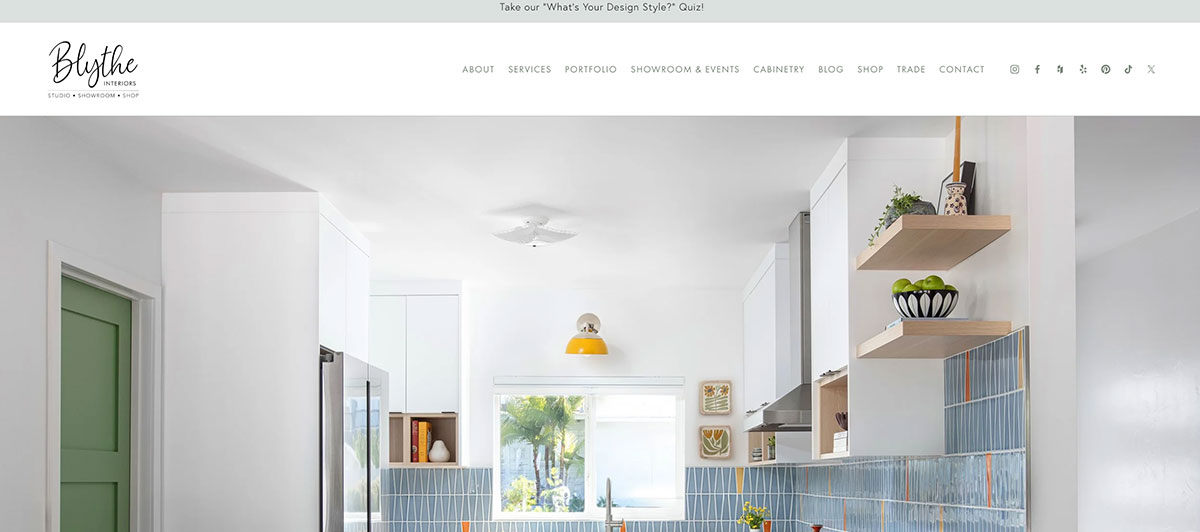
Filled with personality and style, the website design for the San Diego-based company Blythe Interiors gives visitors a taste of what they’ll get if they choose to work with them. Featuring a friendly and personable logo, along with an easy-to-read menu, one of the best features on the website is its straightforward “Design Services” section.
By putting its services directly on the homepage, and boiling them down to three easy-to-understand offerings, potential clients can quickly decide if the company has what they’re looking for. This ability to make a quick “yes or no” decision actually helps, not hinders, conversions because clients who do see exactly what they want feel even more confident, and ready to make a big commitment.
3. Rariden Schumacher Mio & Co.

Style is personal and, as such, unique to everyone. So, while some interior design companies will do what they can to appeal to as many different styles as possible, others will make a bold statement, one that will either attract or repel their potential customers. The website design for Rariden Schumacher Mio & Co. does just that. Black and bold, there’s a definite “vibe” exuded from the website, and it will either appeal to you or it won’t.
If, however, it does, then you won’t just like what you see; you’ll love it. While a calculated risk, the team at Rariden Schumacher Mio & Co. understands that a successful interior design company doesn’t have to have tons of clients. Instead, they can afford to have a smaller, but more loyal, client base that really raves about their work.
4. Kati Curtis Design
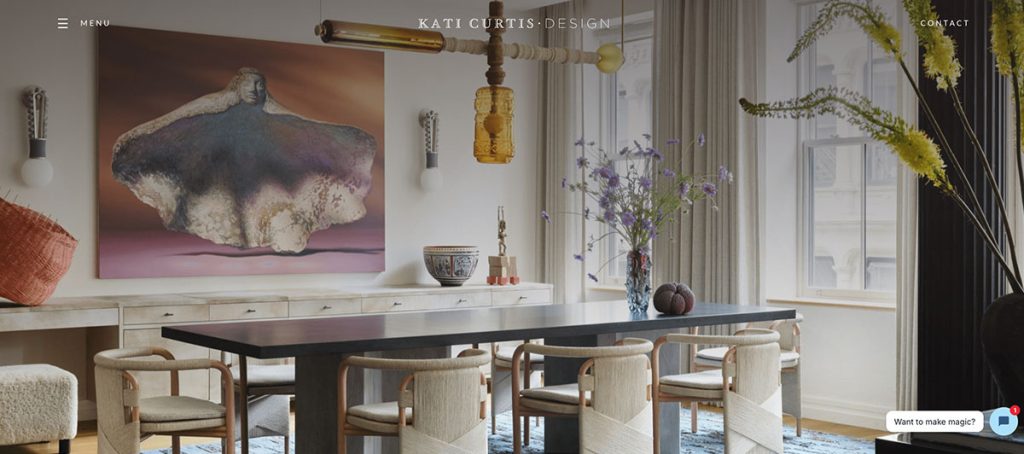
Competing in the huge New York City design market, the website for Kati Curtis Design stands out. Superior in terms of SEO, one of the best things about the Kati Curtis Design website is that it invites you in. Instead of the traditional across-the-top menu, it uses a left-bar menu to immediately draw your eye to the rotating gallery of showcased projects.
And, as you scroll, you’re taken into a thoughtful experience that presents the company and its work alongside elegant and effective buttons, including the laidback “Let’s Chat”. Because the menu stays visible on the left-hand side of the screen at all times, it’s constantly there to invite visitors to continue to explore.
A quick stop on the About page demonstrates the right way to do this as well, using a collage of overlapped pictures and a beautiful “Our Promises To You” section to really come across as kind, caring, and impeccable at what they do.
5. Pfuner Design
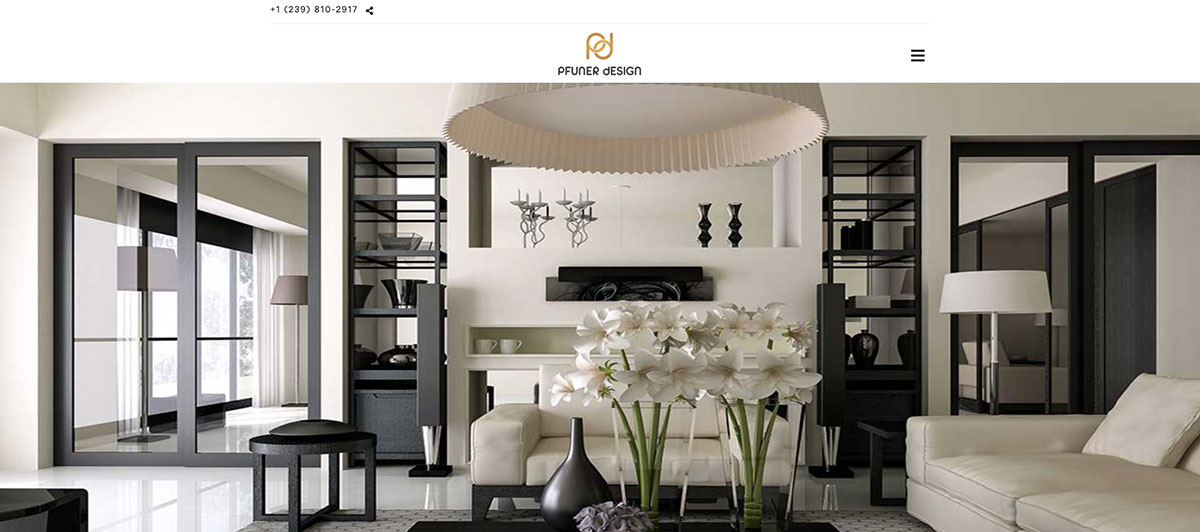
A more robust website experience compared to most interior designers, Pfuner Design opts to put a whole lot of content right at your fingertips from the get-go. This design approach works, however, because of its organization and its commitment to being clean and crisp. Using mostly black and white, the layout of the website’s homepage reads almost like a magazine, providing visitors with plenty of opportunities to engage.
In doing so, the design team also has the chance to flex its muscles when it comes to knowledge and taste, giving potential clients a great chance to get to know them, almost like a “rapid fire” question game at a dating event. Another feature that makes the website unique is that, rather than only showcasing its work, it prominently features a section about its founder and creative director, along with a large photograph of her smiling in a casual chair, rather than a more professional-looking headshot.
This choice makes the entire website feel more personal, giving prospective clients a better understanding of who they would be working with, not just what they’ll be ending up with when the project is complete.
Design choices worth stealing
You don’t need to rebuild your entire site. Sometimes, a few focused changes create the biggest shift. Here are the design tips worth applying directly:
- Lead with your strongest image. The hero section of your interior design site is prime real estate. Use one exceptional photograph that instantly communicates your style, whether that’s modern architecture, layered decor, or vibrant Southern California residential spaces.
- Keep navigation to five items or fewer. Home, Work, About, Services, Contact. That’s the template. Anything beyond that creates friction for users.
- Let your portfolio page breathe. Cramming every project into a grid kills depth. Curate ruthlessly. Show fewer projects with more context, including the brief, the process, the materials, and the final room.
- Use your About page as a trust resource. Clients hire people, not firms. A personal photograph, a clear design philosophy, and a few lines of honest copy go further than a list of credentials.
- Make your CTA feel like an invitation. “Let’s Chat,” “Start a Conversation,” “Tell Us About Your Space.” These phrases reflect a collaborative approach. “Submit” or “Click Here” do not.
- Protect your brand with consistent typography. Two fonts maximum. One for headings, one for body text. Anything more starts to compete with your images for attention.
What your site needs to attract the right clients
Most interior design studios focus on how their site looks. Fewer think carefully about who it’s for. Here’s what the best interior design websites get right on a strategic level:
- Clear specialization. Are you focused on residential decorating? Modern commercial projects? Furniture and accessories sourcing for high-end house renovations? Say it plainly. Visitors who see themselves reflected in your niche become inquiries faster than those who have to guess what you do.
- Photography that tells a story. Images should show more than a finished room. Before and afters, in-progress shots, and detail close-ups of textiles, accessories, and decor all add depth to the portfolio experience. They also show process, which builds confidence in your skills.
- Social proof in the right places. A testimonial buried on a Contact page does little. Inspired placement means weaving client quotes and outcomes throughout the site, especially near CTAs and on service pages.
- A blog or design inspiration section. Regularly publishing design tips, decor ideas, and project spotlights gives users a reason to return and gives Google a reason to rank you. It positions your interior design studio as a genuine resource, not just a service provider. Our SEO services are built around exactly this kind of content strategy for design-focused businesses.
- Mobile optimization. Most users will access your interior design site from a phone. If your images load slowly or your navigation breaks on mobile, you’re losing clients before they’ve even seen your work. Our team builds WordPress websites that look and function beautifully across every platform and app environment.
Turn your portfolio into a lead machine
A portfolio page that only shows pretty images is a missed opportunity. Here’s how to make yours work harder:
- Structure each project as a mini case study. Include the client’s goals, your design approach, the challenges you solved, and the outcome. This gives potential clients a window into your process and helps them picture working with your interior design studio.
- Add a clear next step at the bottom of every project. After a visitor has spent time with your work and feels inspired, they’re primed to act. A simple “Interested in working together?” with a link to your contact page captures that momentum.
- Use project categories to help users self-select. Separate your residential work from your commercial projects. Let visitors navigate to what’s relevant to them. This improves both user experience and the quality of your inquiries.
- Connect your portfolio to your services. If a project showcases a full home renovation, link to your full-service design offering. If it features furniture sourcing and accessories, connect it to your procurement service. The portfolio becomes a platform for discovery, not just display.
- Optimize every image for speed and search. Large, unoptimized images are one of the most common reasons interior design sites load slowly. Compress files, use descriptive alt text that reflects the room, decor style, or project type, and name your image files with relevant keywords. Our WordPress speed optimization service handles this as part of a broader performance strategy.
- Ask for the consultation, not the commitment. The goal of your interior design site isn’t to close a project. It’s to start a conversation. Frame your CTAs around low-friction first steps: a free consultation, a discovery call, or a simple “Tell us about your space” form. That’s how the best websites in the world turn browsers into clients.
If you’re ready to build or redesign your interior design site with a team that understands both web design and what it takes to succeed online, we’re here. Take a look at our best interior design websites roundup for more inspiration, or get a quote and let’s talk about what your next site could look like.
Your interior design site should work as hard as you do. Freshy can help
The best interior design websites share one thing: they make the right first impression on the right people. From a bold color story to a curated portfolio page, every choice either builds trust or breaks it. Get the fundamentals right, and your website becomes your most productive team member.
Key takeaways:
- Your interior design site is the first project that clients judge you on
- Conversion comes from clarity, not just beautiful images
- Navigation, messaging, and CTAs matter as much as aesthetics
- A curated portfolio page with context outperforms a packed image gallery
- Mobile performance is non-negotiable for any modern design studio
- Your About page is a trust-building resource, not an afterthought
We’ve helped businesses across a wide range of industries build websites that look great and actually perform. Our WordPress web design team understands what it takes to craft a site that reflects your brand and converts visitors into inquiries. Get a quote and let’s build something worth showing off.
FAQs
Which site is best for interior design?
Houzz is the leading platform for finding design inspiration across a range of residential and commercial projects, with advice, decor ideas, and professional collaboration tools.
Can ChatGPT do interior design?
ChatGPT offers fun brainstorming and decorating advice, but of course, it can’t replace professional designers for real-world spatial planning, patterns, or detailed project execution.
What is the best website builder for interior designers?
WordPress offers the widest range of design flexibility. Squarespace and Wix are beginner-friendly builders suited to designers wanting a simpler, faster setup without coding skills.
How much does an interior design website cost?
Costs vary by scope. DIY builders start free, while a professionally designed site typically ranges from $1,500 to $5,000, depending on features and collaboration required.
Do interior designers need a website?
Absolutely. A well-built interior design site showcases residential and commercial projects, builds credibility, and generates inquiries around the clock without any extra effort from your team.



)