Handmade products deserve more than a listing on Etsy next to mass production knockoffs. Relying on a single marketplace as your only sales channel is a business risk, and one that’s easy to reduce by owning your own platform where you control the customer relationship entirely. The best artisan websites prove that a dedicated online home, built around a maker’s story and creations, converts far better than any shared marketplace page.
This article showcases 10 of the best artisan websites and what makes each one worth studying.
Here’s what we cover:
- What separates a great artisan website from a generic online shop
- 10 standout artisan websites, reviewed and linked
- The design and storytelling choices that sell handmade products authentically
- Marketplace alternatives like Etsy, Amazon Handmade, and eBay, compared to owning your own site
- How to build an artisan website that grows a loyal community around your work
We build websites for makers, artists, and independent sellers all the time, and the team here genuinely loves this kind of work. Browse our small business web design portfolio and see if something sparks an idea for your own online space.
What makes an artisan website worth visiting
The artisan economy is built on trust. Customers buying handmade items want to know who made them, how they were made, and why they should pay more for something crafted by a person rather than produced by a machine. The best artisan websites answer all three of those questions before a visitor ever clicks on a product.
Here’s what consistently separates the best artisan websites from forgettable online stores:
- They lead with story, not just product. A behind-the-scenes look at the process, a portrait of the maker, and an honest account of why the work matters are worth more than any product description on a shared marketplace. Customers who connect with the person behind the creations become loyal supporters, not just one-time buyers.
- They make the handmade distinction unmistakable. In a world where mass production dominates online search results, the best artisan websites visually and verbally communicate the difference. Real photos from the workshop, process videos, and language that honors the slowness and skill of the craft all signal authenticity that Etsy listing fees and shared platform pages simply cannot deliver.
- They build community, not just a catalogue. Newsletter sign-ups, blog posts, social feeds, and exclusive offers for repeat visitors transform a transactional shop into a place people genuinely want to return to. The best artisan websites blur the line between shop and community hub.
- They protect the customer experience with good technical foundations. A shop that loads slowly, breaks on mobile, or triggers security warnings from malicious bot activity loses customers before they ever see the work. Proper security verification through a reliable hosting setup and site maintenance protects sales and the brand’s credibility simultaneously. Our WordPress security services and maintenance plans handle this for artisan businesses so they can focus on making rather than managing.
| Selling on shared platforms | Owning your own artisan website |
|---|---|
| Listing fees and transaction fees on every sale | One-time and ongoing investment, higher margin per sale |
| Competing with mass production in search results | Full control over how your story and products are displayed |
| Platform owns your customer relationship | You own your customer list and data |
| Limited design and branding control | Complete creative control over your online space |
| Algorithm changes affect visibility | SEO you build compounds over time |
10 best artisan websites of 2026
For this “best of” websites list, we’ve decided to focus more on the traditional definition of “artisan”, rounding up websites that sell (either directly online or via a physical exchange at a later point in time) products that have literally been crafted by hand and as few “extra” tools as possible.
Dedicated to honoring long-held processes and practices, but without any sense of fear or restraint, the artisan websites listed here reflect this slow-grown, down-to-earth demeanor. They also, however, function incredibly well in the modern, fast-paced world almost everyone today lives in, providing an experience that beautifully bridges the space between handmade and online.
If you’re still doing last-minute holiday gift hunting, the inspiration you’ve been looking for might just be on this list. You also might find the inspiration for the new website you’ve been dreaming of. And, if that’s the case, then remember that our team at Freshy is here to take your visions of sugar plums and make them your online reality.
1. Meredith Steele

Meredith Steele Art uses a centered, condensed homepage menu and an immediate dive into the artist’s work to deliver instant gratification. The art is the first thing you see, organized into collections and categories that make exploration easy without requiring any explanation.
The homepage uses as few words as possible, relying instead on the work itself to do the communicating. It’s a design philosophy that makes complete sense for a visual artist: the creations speak, the site supports, and the visitor is given exactly what they came for the moment they arrive.
2. Emily Jeffords
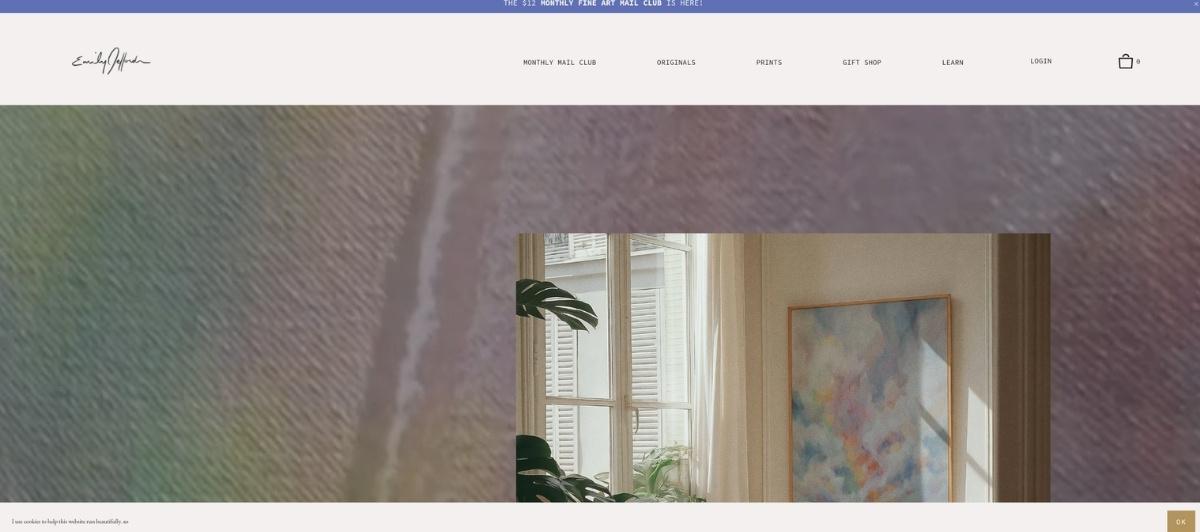
Emily Jeffords’ website is as visually stunning as her landscape paintings, but what makes it exceptional is how effectively it works as a business tool. Lead capture through a newsletter signup, a free guide on framing art, exclusive holiday offerings for VIP subscribers, and courses for fellow artists all create multiple revenue streams from one beautifully designed site.
The lesson here: the best artisan websites don’t just sell creations. They build ecosystems around the maker’s world, turning casual visitors into devoted community members who return again and again for something new.
3. Aurora Shoe Co.

Aurora Shoe Co. has been making leather shoes by hand since the 1990s in Aurora, New York, and the website reflects every year of that heritage. Simple, intuitive, and utterly different from the major shoe retailers online, it uses a humble brand story and a blog featuring real people making real shoes to make an honest case for why buying handmade matters.
The #aurorashoes section in the main navigation pulls in lifestyle images of the brand’s shoes in the wild, functioning as social proof and community showcase in one. It’s the kind of site that makes mass production feel like a poor substitute.
4. WorkOf

WorkOf is an online collective for independent designers and makers that functions like a carefully curated gallery as much as a shop. Beautiful product photography paired with well-written maker stories gives every artisan on the platform a proper introduction, making you feel like you’ve discovered something genuinely rare. Search by product type or by artisan.
Use the chat tool when you need help finding something specific. Explore the gift guide when you want inspiration. For anyone wondering what a great platform for artisans looks like, WorkOf is one of the most interesting examples online of how to honor handmade work digitally.
5. Bowery and Grand

Bowery and Grand is a custom furniture brand based in New York whose website feels as considered as the pieces it sells. Generous white space in the margins creates a sense of calm that makes browsing a pleasure rather than a chore. Unique product photos, most taken from a lower-than-eye-level angle, make each piece look interesting from a perspective you don’t often see in furniture photography.
The site is so straightforward, so free of anything superfluous, that it communicates trustworthiness before a visitor has read a single word. When a website feels like it was built by someone honest and passionate about their craft, that feeling translates directly into sales.
6. Alexander Designs

Alexander Designs is powered by Shopify, a platform many of the best artisan websites use because of its balance between strong standard layouts and significant customization potential. The site balances visual and written content well, and practical tools like a chat feature and search option help customers navigate a jewelry collection that might otherwise feel overwhelming to explore.
A custom logo elevates the whole experience beyond what a standard Shopify template delivers on its own, making it a solid model for any artisan considering a platform-based shop with some additional personality layered on top.
7. Lindsay Letters

Lindsay Letters is an online experience that manages to feel both warm and professional at once. Art sorted into clear categories makes the collection easy to explore without feeling lost. Professional product photography removes the uncertainty that so often prevents customers from buying art online.
But the standout element is the founder’s mission statement, which opens with: “I believe that you are SO WORTHY of meaningful art.” That kind of direct, personal language builds an emotional connection that no amount of clever product copy can replicate, and it turns a shop into a community worth joining.
8. Erin Rigney

Erin Rigney’s website does something most artisan sites don’t dare try: it makes entering feel like an event. A welcoming landing page featuring her work alongside the quote, “Everything around us is art, if we have the eyes to see it that way,” builds anticipation before a visitor even reaches the shop.
When they click through, a beautifully simple experience awaits: curated galleries, a personal story that genuinely makes you want to be friends with the artist, and a live social feed that keeps the site feeling active and evolving. It’s one of the best examples online of how artisans can use their personal story as a homepage.
9. General Store

General Store has physical locations in Los Angeles and San Francisco and is known as a destination for handmade and artisanal goods for home and life. The website captures as much of that spirit as a screen can manage. Grid-based product photography, similar in feel to a curated Pinterest board, creates a visual collection worth getting lost in.
The shopping experience itself is simple and streamlined, making it effortless to discover new products and add them to your cart without the friction that ruins so many artisan online stores. For makers considering how to present a wide range of handmade items without overwhelming the customer, this site is worth studying closely.
10. Melitta

Melitta sells a coffee-related product, but the website feels less like a shop and more like an invitation into a world. Stunning photography, theatrical video, and a brand story that delivers a genuinely interesting history of our culture’s love of coffee all work together to make the product feel like the natural conclusion of a great story.
Images appear as you scroll, keeping the experience dynamic. Every design choice creates the sense that what you are about to buy is worth caring about. For artisans wondering how much storytelling is too much, Melitta’s answer is: you can go further than you think.
11. Whiskey and Clay

Whiskey and Clay sells handmade ceramics with a website so curated it feels like a statement in itself. The homepage features only black and white images, making the brand’s story the main attraction rather than the products. From inspiration to process to where to find the work, the site takes you on a journey that makes you feel connected before you ever consider buying.
A small product range, currently just four items displayed online, works entirely in the brand’s favor. A focused collection lets you spend real time with each piece rather than scrolling past dozens. The Press section, featuring articles and features about the brand, provides additional depth for anyone who wants to know more.
Selling on Etsy vs. owning your own artisan website
Every maker faces this question at some point. Etsy, Amazon Handmade, and eBay offer built-in traffic and an existing buyer community. Your own website offers something more valuable in the long run: ownership.
Etsy raised its transaction fee from 5% to 6.5% in 2022, made Offsite Ads mandatory for sellers over $10,000 in revenue, taking another 12 to 15% off the top, and search visibility has become increasingly pay-to-play. You don’t own the relationship with your customers. Etsy does.
Here’s how the main options compare for artisans thinking about where to sell:
| Platform | Best for | Listing fees | Who owns the customer? |
|---|---|---|---|
| Etsy | Discovery and first sales | Yes, plus transaction fees | Etsy |
| Amazon Handmade | Scale and reach | No listing fees, 15% referral fee | Amazon |
| eBay | Broad audience, flexible products | Variable | eBay |
| Your own website | Brand control, community, long-term growth | None beyond hosting | You |
The smartest strategy for most artisans combines both. Use Etsy or Amazon Handmade to drive discovery and generate initial sales. Build your own site as the place customers come back to, where you control the experience, collect email addresses, and keep more of every sale you make. Our WooCommerce development services make building a fully functional artisan shop on WordPress straightforward and scalable.
What every artisan website needs to succeed
The 10 best artisan websites above all share specific features that move visitors from browsing to buying. Here’s what to prioritize when building or improving your own.
- A dedicated story page that goes beyond biography. Not just “who I am” but “why I make,” “how I make it,” and “what I hope it does for the person who takes it home.” This is the content that turns a browsing stranger into a loyal customer who tells their friends about your work.
- Process photography and video. Behind-the-scenes images and short videos of the making process are among the most powerful trust signals on any artisan website. They prove the handmade claim visually and create an emotional connection to the product that no product page can replicate on its own.
- A curated, well-organized collection. More products displayed poorly is worse than fewer products displayed beautifully. Every handmade item deserves a professional photograph, a thoughtful description, and a clear category. If your product range is small, treat that as a feature rather than a limitation.
- A newsletter with a real reason to sign up. Exclusive early access to new creations, a discount on the first order, a behind-the-scenes look at the next collection. Give customers a specific reason to stay connected, and your newsletter list becomes the most valuable sales tool your artisan business owns.
- Security and performance that protect every sale. An artisan website that loads slowly or triggers a security warning from malicious bot traffic loses sales silently every day. A fast, secure, well-maintained site is as important as beautiful photography. Our WordPress hosting and speed optimization services keep artisan sites performing well so the craft gets the attention it deserves, not the tech.
Your craft deserves more than a listing page — claim the online space that’s actually yours
The best artisan websites share one thing: they make a customer feel something before they buy anything. The story, the process, the person behind the work. These are the elements that mass production can’t copy and that no shared marketplace can replicate. Owning your own site is how you protect that advantage and build something that compounds over time.
Key takeaways:
- Story and process content convert artisan website visitors into loyal buyers more effectively than product pages alone
- Owning your own platform means owning the customer relationship, the data, and the long-term margin
- A curated, well-photographed collection outperforms a cluttered catalogue every time
- Marketplace platforms like Etsy and Amazon Handmade are useful for discovery, but shouldn’t be your only channel
- Newsletter sign-ups and community content transform a shop into a destination people return to
- Site security, speed, and maintenance protect every sale you’ve worked hard to earn
The right website doesn’t just sell your work. It represents it. If you’re ready to build an online home that does justice to everything you make, start a conversation with our team and let’s figure out what that looks like for you specifically. Your craft is one-of-a-kind. Your website should be too.
FAQs
What should an artisan website include?
The best artisan websites feature a genuine maker story, process photography or video, a curated product collection, apps for inventory and shipping management, a newsletter sign-up, and a checkout experience that builds confidence in buying handmade directly from the company behind the creations.
Is it better to sell on Etsy or your own artisan website?
Both serve different purposes. Etsy verifies buyer and seller activity and is a great place to drive initial discovery. Your own website is literally the best place to build long-term brand equity, keep more money per sale, and own the customer relationship entirely, something other sites cannot offer.
Do artisan websites need a security service?
Yes. A security service that performs performing security verification checks protects your shop from malicious bot traffic and fraudulent orders. Users expect safe checkout, and waiting on a slow or insecure site costs real sales. Technology that handles this automatically is worth every penny.
How do artisan websites compete with mass production online?
Imagine walking into a workshop and watching something be made by hand. That is what great artisan websites recreate digitally. A security service that verifies the site is legitimate, combined with honest storytelling, process photography, and real shipping details, builds the trust that mass production simply cannot buy.
What platform is best for selling handmade products online?
WordPress with WooCommerce gives artisans the most control, scalability, and access to apps covering shipping, inventory, and security verification. Shopify is a strong alternative. Etsy and Amazon Handmade are a great place to generate traffic alongside a dedicated company site, not instead of one.
How much does an artisan website cost?
A professionally built artisan website typically costs $2,000 to $6,000. The investment pays for itself by eliminating listing fees on other sites, keeping more money per sale, and building a direct customer relationship that no marketplace, no matter how much technology it uses, can replicate.