

Choosing a urologist is one of the most personal healthcare decisions a person makes. Patients often research online for weeks before they call anyone, reading physician bios, scanning patient reviews, and checking whether a practice treats their specific urologic conditions. The website they find in that research phase determines whether they feel confident enough to book. A poorly designed site sends them to a competitor without a second thought.
This article reviews 20 of the best urologist websites and what each one gets right.
Here’s what we cover:
- What makes a urologist’s website earn patient trust before the first visit
- 20 standout urologist websites, reviewed and linked
- The design and content choices that distinguish top practices online
- What every urology practice website needs to attract and convert new patients
- How to build a site that reflects your team’s expertise and subspecialties
We’ve built healthcare websites that turn site visits into scheduled appointments, and our healthcare web design work reflects exactly that level of care. Take a look when you’re ready.
What makes a urologist website earn patient trust
Urology is a sensitive specialty. Patients dealing with kidney stones, prostate concerns, urologic oncology diagnoses, vasectomy questions, or pediatric urology needs for their children arrive at a practice’s website already anxious. The last thing they need is a site that looks outdated, loads slowly, or buries the information they need behind confusing navigation.
There are approximately 13,000 practicing urologists nationwide, and the majority of urology groups are concentrated in urban areas. In competitive markets, the practice with the more professional, better-organized website consistently wins the patient inquiry.
Here’s what the best urologist websites consistently get right:
- They make the physician human, not just credentialed. Patients choosing a urologist want to know the person they’re trusting with a sensitive diagnosis. A clear physician photo, a bio that includes both credentials and communication style, and a video introduction all help reduce the anxiety of scheduling with someone new. The best urologist websites treat the physician bio as a conversion tool, not a formality.
- They organize urologic conditions and subspecialties clearly. Urology covers an enormous range of conditions affecting men, women, and children: kidney stones, prostate disease, urologic oncology, incontinence, male fertility, pediatric urology, and more. Patients arrive searching for a specific condition, and the site must connect them to relevant information quickly. Organized subspecialty pages with plain-language descriptions help patients confirm they’ve found the right practice before they ever pick up the phone.
- They make scheduling effortless. An online appointment request button visible above the fold, a click-to-call number in the header, and a patient portal link for existing patients are the baseline for any modern urology practice website. Telehealth scheduling links have become equally important since the pandemic expanded virtual urology care significantly.
- They build trust through social proof and research credibility. Patient testimonials, physician media appearances, clinical trials participation, Urology Care Foundation affiliations, and hospital partnerships all signal that this is a practice worth trusting. The best urologist websites present these signals naturally throughout the site rather than confining them to a single About page.
| Weak urologist website | High-converting urologist website |
|---|---|
| Generic stock photos of doctors | Real physician photos with bios and media appearances |
| Service list with no condition detail | Dedicated pages for each urologic condition with plain-language explanations |
| No online scheduling | Online appointment request and telehealth booking above the fold |
| No patient testimonials | Reviews woven throughout, near CTAs and physician profiles |
| No insurance or location information | Insurance accepted and all office locations clearly displayed |
20 urologist websites you should see in 2026
The choice of a urologist isn’t something that most people take lightly. A good website assures them that they’ve found a safe treatment facility that features some of the top experts in their field. Visitors can find important information at a glance and get in touch with the facility with a few clicks of a mouse.
1. Arizona Urology Specialists
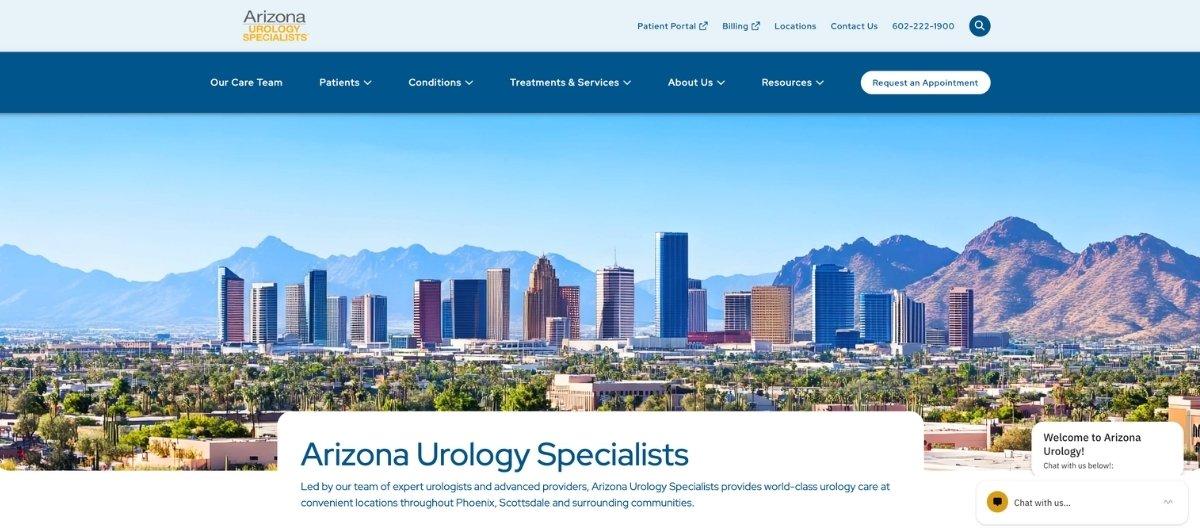
Arizona Urology Specialists opens with an immediately warm, approachable atmosphere: a friendly patient smiling at his phone, paired with bright primary colors that draw attention to exactly the right content blocks.
The link to schedule a telehealth appointment is prominently positioned, which shows the practice understands how its patients actually want to access care. For a large regional urology practice serving patients across multiple locations, this site communicates scale without losing the personal warmth that makes patients feel comfortable enough to book.
2. Dr. Richard Bevan-Thomas
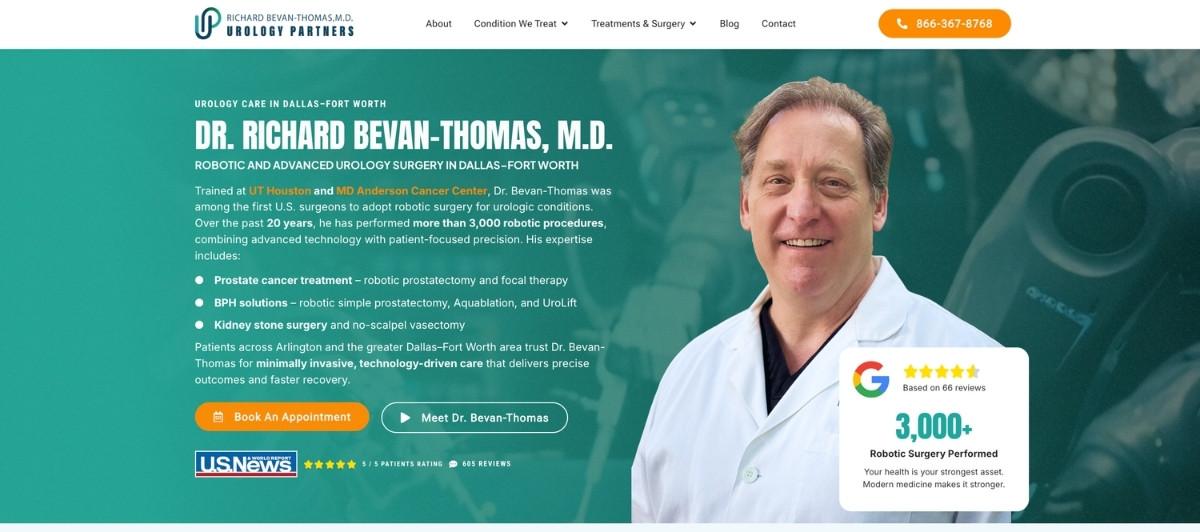
The website for Dr. Richard Bevan-Thomas uses sophisticated shades of gray and aqua to project the kind of adult, professional atmosphere that a urology practice focused on men’s health needs to communicate immediately.
The homepage leads with a clear photo of the doctor alongside an invitation to read his biography, making the physician feel accessible and knowable before a patient ever contacts the office. This human-first approach to physician introduction is one of the most effective trust-building strategies on any urologist website in this list.
3. Murray Hill Urology

Murray Hill Urology solves one of the most common problems on healthcare websites: the disappearing CTA. A “Book Online” button anchored in the bottom-right corner follows visitors as they scroll through every page, ensuring the next step is always visible regardless of how deep into the site they’ve gone.
Three prominent buttons above the fold, offering call, appointment request, and contact form options, serve different patient preferences simultaneously. For a urology practice that wants to maximize appointment conversions from every page, this site is an efficient model.
4. The Urology Place

The Urology Place uses a newsletter sign-up pop-up on arrival to convert visitors who aren’t yet ready to schedule, keeping the practice in contact with potential patients through deals and health updates delivered directly to their inbox.
When visitors close the sign-up, they find a direct invitation to talk to a staff member, which serves the patient who is ready to ask questions but not yet ready to commit to an appointment. These two conversion paths together serve a wide range of patients at different stages of their decision-making process.
5. Houston Metro Urology

Houston Metro Urology uses a clean blue-and-white color scheme to immediately project the clinical professionalism patients expect from a urology practice while keeping the experience warm enough to reduce anxiety.
The homepage patient testimonials and featured newest treatment information give both emotional and clinical reassurance in the same scroll. A pop-up makes telehealth and in-person visit scheduling equally accessible, reflecting the practice’s commitment to serving patients across the region regardless of how they prefer to receive care.
6. Y. Mark Hong, M.D.
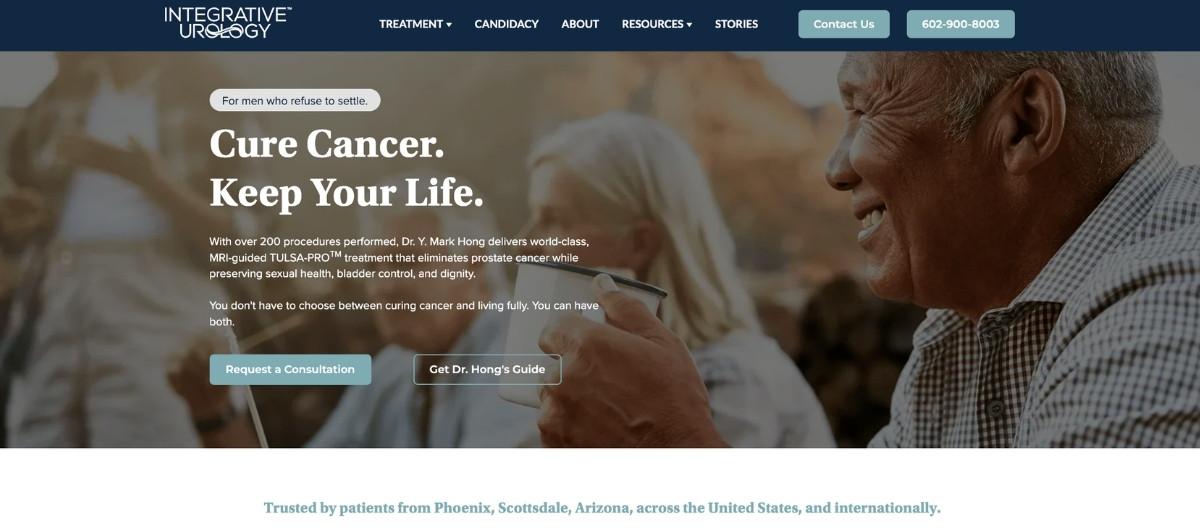
The website for Y. Mark Hong, M.D. places the office phone number directly in the top navigation bar, ensuring the most important conversion element is visible before a patient reads a single word of content.
Short, well-written blocks of copy explain Dr. Hong’s education and achievements without requiring visitors to navigate to a separate About page. Patient testimonials and a featured “Good Morning America” video appearance give this urologist’s website the kind of third-party credibility that builds trust faster than any self-promotional copy can.
7. Star Urology of Texas

Star Urology of Texas uses a yellow and blue color combination to create an immediately cheerful, accessible atmosphere that is notably different from the typically serious aesthetic of most urologist websites.
This tonal choice is a strategic one: patients dealing with sensitive urologic conditions benefit from a visual environment that feels welcoming rather than clinical. The homepage provides concise location information and a direct appointment request link, keeping the experience efficient for patients who arrive ready to schedule.
8. Women’s Urology New York

Women’s Urology New York communicates geographic permanence and specialty focus simultaneously with a full-color New York City skyline image, a signal to female patients in the area that this practice is a committed, established part of their community.
Contact information and a direct inquiry form are both immediately visible, removing two of the most common barriers between a new patient and her first appointment. For urology practices specifically serving women, this site is one of the clearest examples of how to make that specialization feel like a strength.
9. Arizona Urology

Arizona Urology prioritizes contact options above everything else, placing call and appointment buttons front and center so patients who arrive ready to act don’t have to search through homepage content before connecting with the office.
An eye-catching color photo block provides visual links to the full range of subspecialties, including robotic surgery, giving patients a clear path to find the specific urologic condition or treatment they’re researching. The clean, organized structure serves both decisive patients and those still in the research stage.
10. San Antonio Urology Medical Group, Inc.
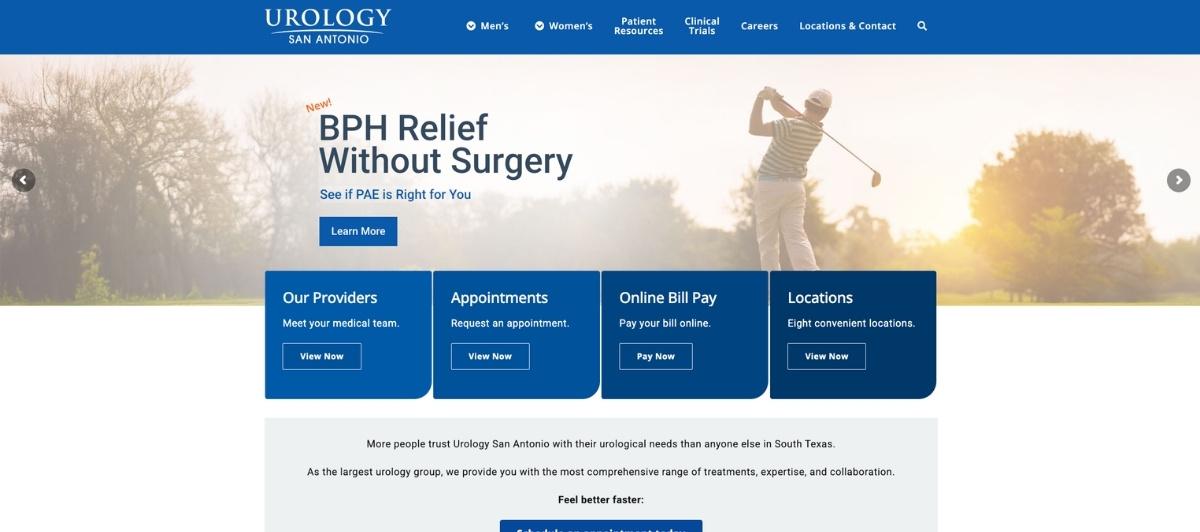
San Antonio Urology Medical Group, Inc. uses large, legible text throughout to prioritize accessibility for an older patient demographic that makes up a significant share of most urology practices. A dynamic slideshow communicates the breadth of urologic conditions treated and the expertise of the physician team without requiring patients to navigate away from the homepage. The appointment request button in the top-right corner is positioned exactly where patients expect to find it based on standard web browsing behavior.
11. Alan D. Garely, M.D.

The website for Alan D. Garely, M.D. stands out for the depth of condition-specific information it provides. Extensive coverage of the urologic conditions treated, paired with photos and brief bios of every physician and nurse practitioner on the team, gives patients a thorough picture of the practice before their first visit.
A full FAQ section on the homepage addresses the questions patients most commonly have before scheduling with a new urologist, reducing the hesitation that costs practices appointment conversions every day.
12. San Diego Urology Associates

San Diego Urology Associates takes an educational approach to patient engagement, featuring videos that introduce the practice and its physicians in a format that helps patients feel they already know the team before they arrive.
The homepage lists insurance companies accepted alongside conditions treated, addressing two of the most common pre-appointment questions in a single scroll. Social media links give patients additional ways to stay connected with the practice between visits, building the ongoing relationship that drives referrals.
13. Central Arizona Urologists
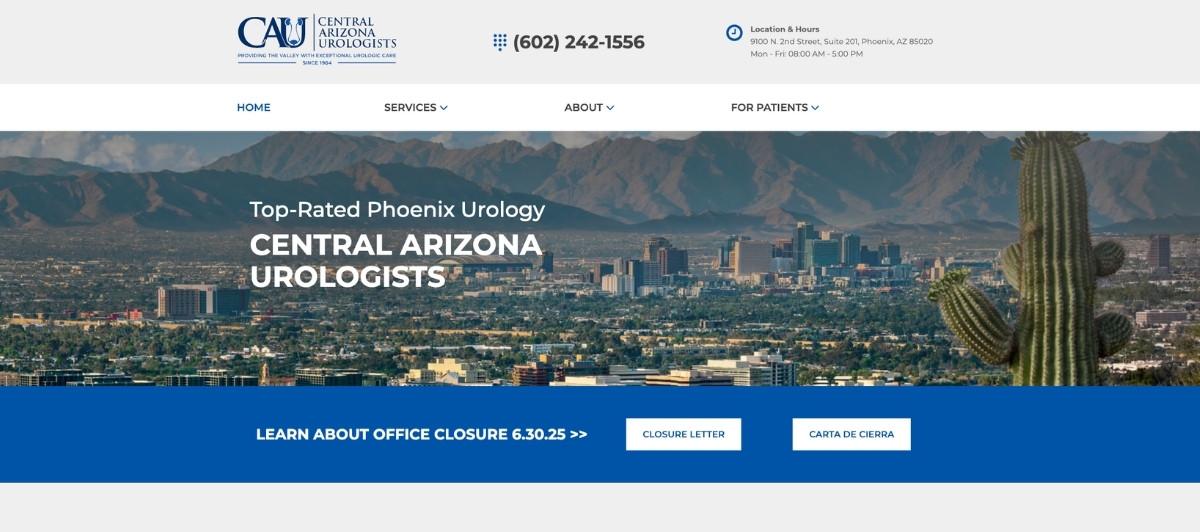
Central Arizona Urologists combines high-contrast white text and blue buttons with a menu bar that prominently displays the address, office hours, and phone number before a patient reads a single line of content.
Prominent buttons for new patient scheduling and introductory forms serve the specific needs of patients arriving at the site for the first time, reducing the friction between landing on the page and taking the next step. The organized, no-nonsense structure reflects the clinical confidence patients want from a urology practice in their region.
14. Columbia University Department of Urology
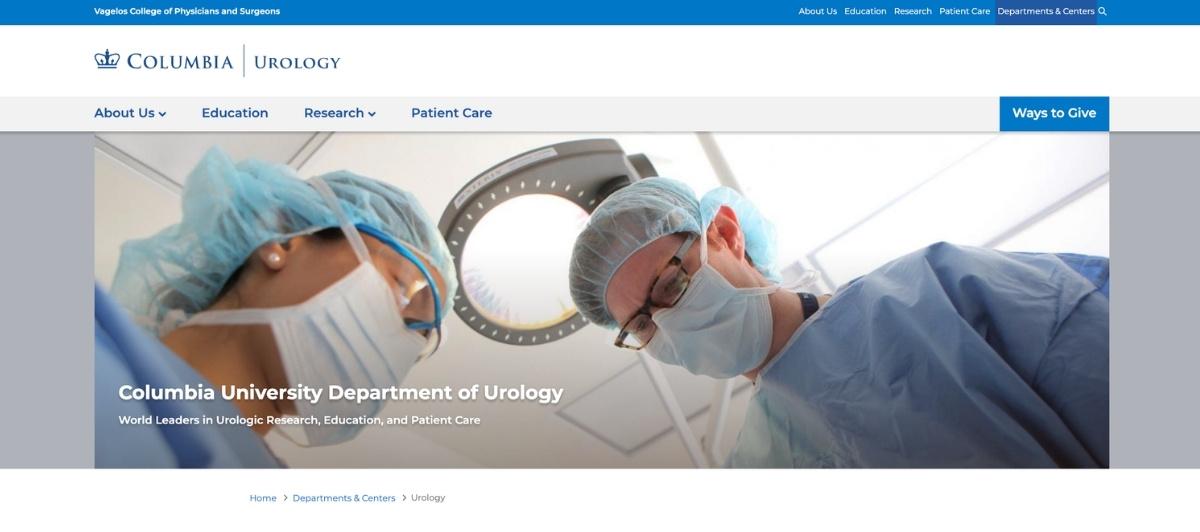
Columbia University Department of Urology combines institutional credibility with genuine patient accessibility in a way that few academic medical center websites achieve. News and events from the facility, physician-patient imagery in the slideshow, and a cleanly organized service structure all communicate that this is both a leading research institution with active clinical trials and a place where individual patients receive attentive, expert care. For practices at the intersection of research and clinical urology, this site is one of the most complete models available.
15. Dr. Lauren Byrne, M.D.

Dr. Lauren Byrne, M.D.’s website uses a clean white layout with carefully chosen blue and green accents to project medical professionalism while maintaining warmth. A direct contact form visible as visitors scroll makes reaching the office easy without requiring navigation to a separate contact page.
The homepage biography positions Dr. Byrne as both credentialed and approachable, a combination that is particularly important for female patients seeking a urologist they can discuss sensitive conditions with comfortably.
16. Urology Clinics of North Texas

Urology Clinics of North Texas manages the challenge of presenting a large multi-physician practice without feeling impersonal. Bios for all 47 providers are organized and easy to find, giving patients the ability to research and select a physician they connect with before scheduling.
A regularly updated blog gives the practice an ongoing platform for patient education on urologic conditions, kidney stones, prostate health, and related topics, which also supports the site’s local search visibility over time.
17. Clavell Urology

Clavell Urology leads with a bulleted list of the major urologic conditions treated at the clinic, immediately answering the most common first question any new patient has: do you treat what I’m dealing with? Social media links in the menu bar and a prominently displayed phone number at the top of the page give patients multiple ways to connect, each requiring minimum effort. For a men’s health urology practice, this direct, no-frills approach communicates confidence and clinical focus in equal measure.
18. David M. Nudell, M.D.
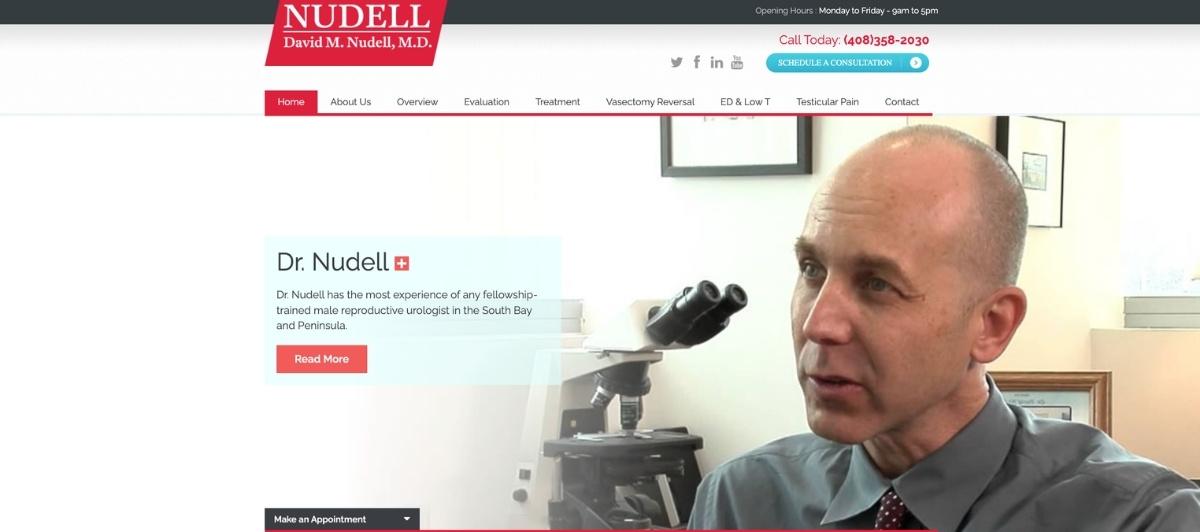
David M. Nudell, M.D.’s website uses strategic red accents to guide the eye toward the most important content and CTAs without overwhelming the clean overall design. A brief homepage biography paired with a direct link to a more detailed credentials page serves patients at two different stages of their research: those who want a quick check and those who want to learn everything before they schedule. The site’s appointment flow is deliberately simple, which respects the time of patients who arrive ready to take the next step toward treatment.
19. New York Urologic
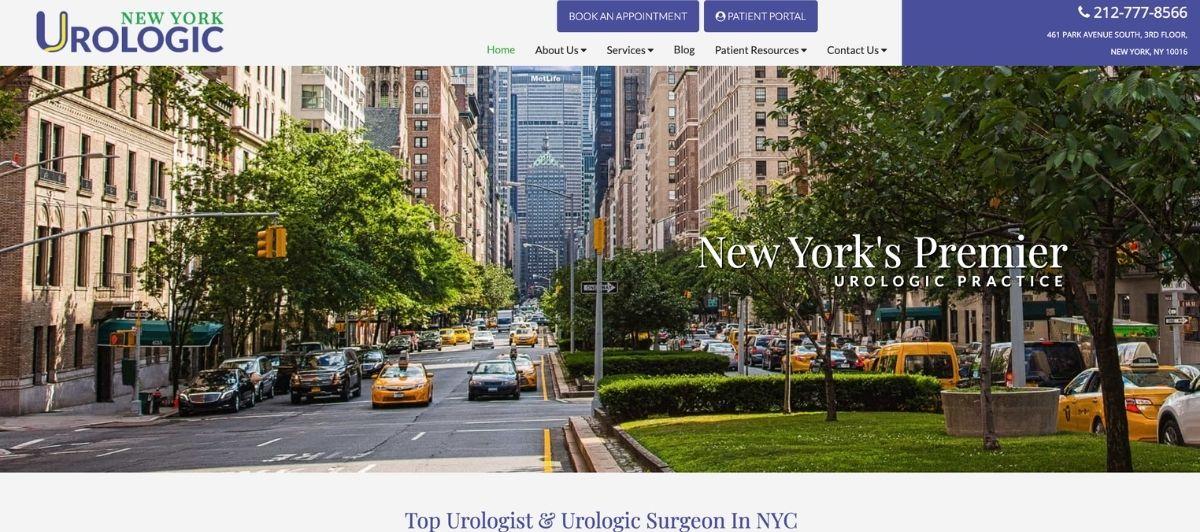
New York Urologic uses generous white space and clearly organized content blocks to create a homepage that feels calm and professional rather than crowded or overwhelming. A full-color Manhattan header image communicates geographic identity and permanence for patients in the area.
The “Book Online” button, highlighted in bright yellow, and a patient portal link positioned beside it serve both new and existing patients simultaneously, making the homepage function as a complete access point for every type of visitor.
20. Austin Urology Institute

Austin Urology Institute earns its place on this list for a design choice few urology practices make: using photography of active, healthy men to communicate what life looks like after successful treatment rather than what disease looks like.
A bright white-and-green layout reinforces the message of energy and wellbeing. The dynamic scroll layout keeps the experience engaging as visitors explore the practice’s services, physician team, and patient resources, making this one of the more memorable urologist websites from a pure user experience perspective.
Design choices worth applying to your own urology practice site
Looking across all 20 urologist websites above, several design and content decisions appear consistently on the sites that convert visitors into scheduled appointments. Here’s what’s worth prioritizing.
Lead with the physician, not the practice name
Patients choosing a urologist are choosing a person, not just a facility. Sites like Dr. Richard Bevan-Thomas and Y. Mark Hong, M.D., both demonstrate that leading with a physician photo, bio, and media appearances builds personal trust faster than any institutional branding can. For single-physician practices especially, the doctor’s face and story belong above the fold.
Organize by urologic condition, not just service type
Patients search for their condition, not your service category. A page titled “Kidney Stone Treatment” performs better in local search and serves patients more directly than a general “Services” page that mentions kidney stones in passing.
Dedicated condition pages covering prostate concerns, urologic oncology, vasectomy, pediatric urology, and women’s urologic conditions each attract different patients with different search intent. Our SEO services help urology practices build exactly this kind of condition-specific content structure.
Make telehealth and online booking equally prominent
Most urology practices now offer telehealth visits alongside in-person appointments. Presenting both options with equal prominence, as Houston Metro Urology does, serves the full range of patients in a practice’s region, including those who prefer virtual care for initial consultations or follow-up appointments after a treatment plan has been established.
Use educational content to build ongoing authority
Fill your website with relevant content that patients are searching for, and make it engaging to encourage readers to schedule appointments so a urologist can address their concerns. Blog posts, videos, and condition guides covering topics like kidney stone prevention, prostate screening timelines, what to expect from a da Vinci robotic procedure, or the latest advances in urologic oncology all attract organic traffic and position the practice as the most credible resource in its region.
Feature patient testimonials near CTAs, not just on a separate page
The sites that convert most effectively, including Petra Flooring from our flooring article and the urology sites on this list, like Houston Metro Urology and Clavell Urology, weave patient reviews near appointment buttons rather than saving them for a standalone testimonials page that most visitors never reach.
What every urology practice website must have
Whether your practice is a solo urologist or a multi-location group with dozens of physicians, these are the non-negotiables for any urologist website serving patients in 2026.
- Online scheduling and telehealth access, prominently displayed. The ability to request an appointment or schedule a telehealth visit directly from the website is now a baseline patient expectation. Practices that require a phone call to schedule lose patients to those that offer instant online booking.
- Condition and subspecialty pages with plain-language content. Patients researching urologic conditions before their first appointment need information they can actually understand. Pages covering kidney stones, prostate disease, urologic oncology, vasectomy, pediatric urology, and women’s urology should each explain the condition, the available treatments, and what patients can expect from the process in clear, accessible language.
- Physician bios that include both credentials and personality. Board certifications, fellowship training, clinical trials involvement, and Urology Care Foundation affiliations establish clinical credibility. A brief note about the physician’s approach to patient care and communication style makes the bio convert. Both matter.
- Insurance accepted and all office locations, clearly visible. For a specialty practice, insurance coverage is one of the first things patients check before booking. Display accepted plans prominently on the homepage and on a dedicated insurance page. For multi-location practices, each office location should have its own page with address, hours, parking, and a map.
- ADA compliance and mobile-first design. Urology patients include older adults who may be using screen readers or larger text settings. ADA-compliant design ensures every patient can access the care information they need. Our WordPress ADA compliance services help medical practices meet these standards without compromising their design quality.
- A patient portal link accessible from every page. Existing patients managing ongoing care, reviewing their treatment plan, or requesting prescription refills need fast access to the patient portal. This should appear in the main navigation, not buried in a footer.
Your patients are searching right now — Freshy helps your practice get found and chosen
The best urologist websites share one quality: they make every visitor feel they have found the right doctor before a single word is spoken. From the physician bio to the condition pages to the online booking button, every element should serve the patient who is anxious, researching carefully, and ready to trust a practice that looks like it knows what it’s doing.
Key takeaways:
- Leading with a real physician photo and bio converts new patients more effectively than any institutional branding
- Condition-specific pages for kidney stones, prostate disease, urologic oncology, and pediatric urology serve both patient needs and local search performance
- Online scheduling and telehealth booking should be equally visible and equally easy to access
- Patient testimonials placed near CTAs convert undecided patients faster than a standalone testimonials page
- Educational blog content and videos build long-term organic search visibility for urology practices
- ADA compliance and mobile-first design ensure every patient in your region can access your site without barriers
The right urology website doesn’t just look professional. It actively earns the trust of patients who are making one of the most personal healthcare decisions they’ll face. If your current site isn’t doing that, start a conversation with our team and let’s build one that does. You can also review our healthcare portfolio to see the standard we set for medical practice websites.
FAQs
What should a urologist website include?
The best urologist websites feature physician bios with credentials and photos, condition-specific pages for urologic conditions, online appointment scheduling, telehealth access, insurance information, patient testimonials, a patient portal link, and a mobile-friendly design.
How do urologist websites attract new patients?
A successful urology website combines local SEO, content that patients are actively searching for, and clear calls to action that encourage readers to schedule appointments. Condition pages covering kidney stones, prostate health, and urologic oncology attract high-intent organic traffic consistently.
Should urologist websites include educational content?
Yes. Blog posts, videos, and condition guides on topics like kidney stone prevention, prostate screening, and advances in da Vinci robotic surgery build authority, attract organic search traffic, and give patients the information they need to feel confident booking with a specific practice.
How important is mobile design for urology practice websites?
Critical. Most patients research urologists on their phones. A site that doesn’t load fast or display correctly on mobile loses potential patients before they ever see the physician bios or scheduling options. ADA compliance matters equally for the older adult population that makes up a significant share of urology patients.
How much does a urologist website cost?
A professionally built urologist website typically costs $3,500 to $12,000, depending on the number of physicians, condition pages, patient portal integration, telehealth scheduling features, and whether ADA compliance and local SEO structure are included from the start.
What is the Urology Care Foundation website, and why does it matter for patients?
The Urology Care Foundation is the official foundation of the American Urological Association. It funds research, supports clinical trials, and provides patients with reliable education on urologic conditions, treatment options, and advances in urology care.
Do urologist websites cover pediatric urology services?
The best urologist websites dedicate separate pages to pediatric urology, helping parents find answers about urologic conditions in children, understand available treatments, and schedule consultations with physicians who specialize in caring for young patients.




)