Manufacturing sells to the most demanding audience on the internet: technical buyers who arrive knowing exactly what tolerance, material, or certification they need. They aren’t browsing for inspiration. They’re verifying whether your capabilities match their spec, and they’ll leave in seconds if the answer isn’t obvious. That makes manufacturing website design a very different discipline from consumer web design.
Here’s what this guide covers:
- The best manufacturing websites of 2026, reviewed
- What technical buyers and procurement teams actually need from a site
- The proof points that build technical credibility
- The performance fundamentals that keep buyers from bouncing
- The interactive tools and industry shifts defining manufacturing in 2026
Industrial buyers are unforgiving readers, and building a site that satisfies an engineer and a procurement lead at the same time takes real structure. That’s the sort of problem our team enjoys, and the WordPress design work behind the examples below shows the standard.
The top 8 manufacturing websites for 2026
When customers think of manufacturing businesses, they don’t necessarily consider what makes each different. It may not look like it to an outsider, but manufacturing is a very large industry with a lot of specializations, so a great website helps communicate what’s particular about the services and character of a given company.
Manufacturing companies especially benefit from designs that don’t sacrifice clarity of vision for easy navigation and load times.
Since the industry is so hands-on due to the nature of the work, many successful sites use video loops and high-res images of the nitty-gritty sides of their services coupled with finished examples of how their work helps customers meet their needs.
1. Tymetal Corp.

Tymetal is a leading security gate manufacturer and provides their customers with a litany of options for different security needs. Their website offers descriptions of their work history and expertise by using their homepage image slider as a sub-page menu, with clickable text that describes each image as a recent example of a security manufacturing skill.
It’s especially easy to navigate through different types of gates and industries, and their educational resources for each potential customer helps inform more in-depth in order to help secure new business through clear explanation of a complex topic.
2. Independent Machine Company

As one of the largest and independent machine stores in the United States, Independent Machine Company‘s site does an excellent job informing visitors about the specific services they offer just below their homepage’s image slider. Each of their four service types has a longer descriptive chunk because of the general and multi-part processes involved in any project they commit to.
To further avoid getting lost in text, each description comes with extensive pictures for examples so new visitors don’t feel lost when learning about a new topic.
3. Fairlawn Tool Inc.
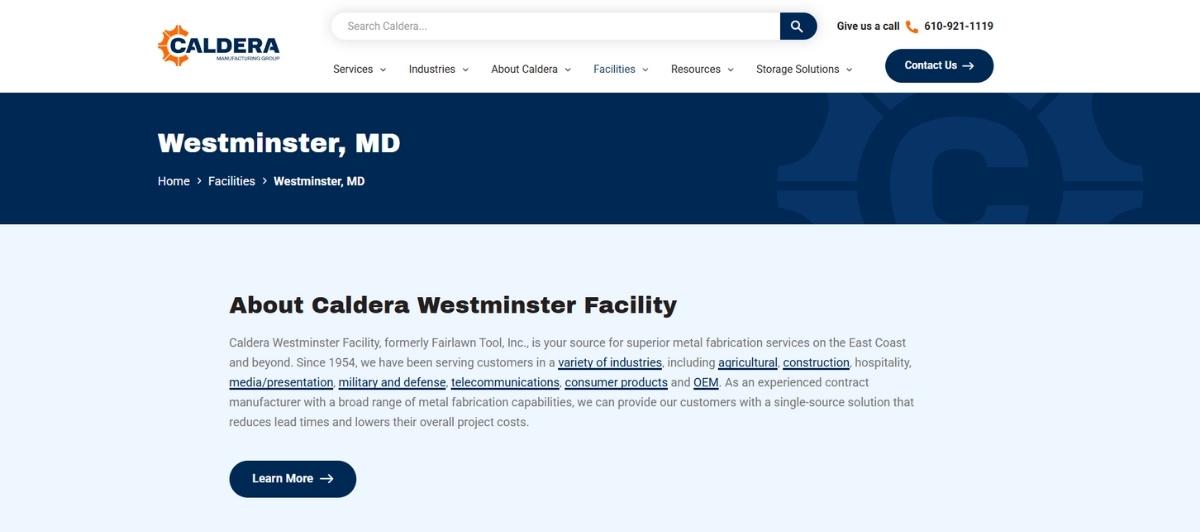
Fairlawn Tool Inc. offers metal fabrication resources all over the East Coast and beyond. With an image-heavy design, Fairlawn’s site scales perfectly across mobile and full-size computing devices and shows action-oriented scenes that depict corresponding services without too much text.
Their homepage’s thorough description of what needing metal manufacturing looks like, along with their company’s guiding philosophy, builds credibility with new and returning customers. They smartly list their industry-specific certifications and their most common high-volume specialty products for bulk orders their customers likely need.
4. Cisco
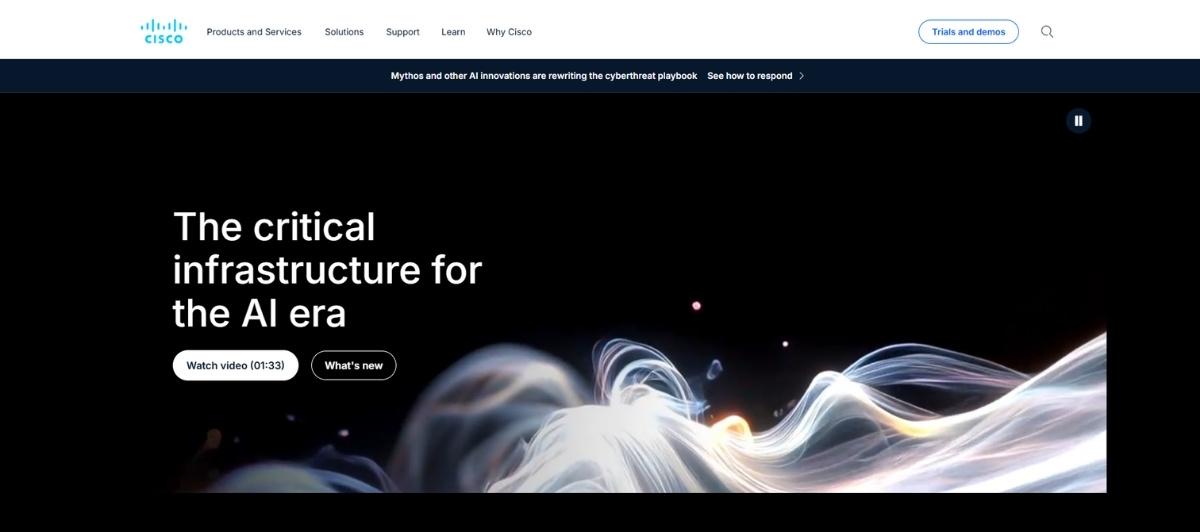
Cisco‘s homepage immediately shows off their well-balanced navigation sequence: a three-level horizontal menu from their expanded header bar with images that mix important calendar dates, data distribution methods, and web security implementation topics.
Since they’re a very large technology service manufacturer and provider, their recent blog entries are organized more thoroughly than most, with subcategories for the most relevant genres of the post in the upper left corner of each thumbnail so visitors know what they’re getting into. The site’s header bar’s “more” tab offers quite a bit more, with sections for different technology certifications, future webinars, and how to become an employee.
5. Lockheed Martin
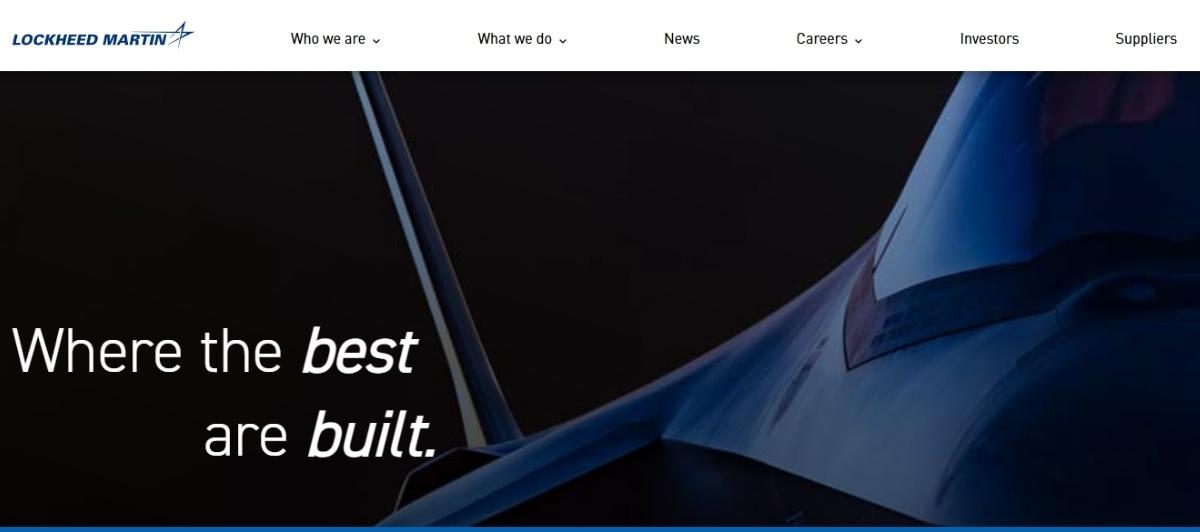
Visitors know Lockheed Martin means business right from the homepage. The main image slider shows a missile’s space-flight trajectory with their slogan, “revolutionizing hyperspace technologies,” just under to show the level of sophistication and cutting-edge expertise visitors should expect.
Throughout the site, high-resolution graphics help viewers believe in the critical nature of their work, and their extensive press release section offers recent imagery for each technological product or social event relevant to their recent services.
Everything feels crisp and recent, and for a company specializing in emerging technology for large businesses and government institutions, one would be hard-pressed to ask for designs more relevant to their character and what they offer.
6. Zeon Chemicals

Zeon Chemicals knows that grabbing customers’ attention is one of the most powerful things a first impression can offer. As a company that has produced specialized elastomers since the 1950’s, their site focuses on presenting their legacy as a business and describing just what elastomers are for new customers looking for guidance.
Their main slogan, “Innovative Elastomers. World-Class Service.” suggests their industry expertise while emphasizing their ability to communicate it to the public. Their site loads very quickly and doesn’t sacrifice compelling copywriting and action-packed images of experts at work.
7. Caterpillar
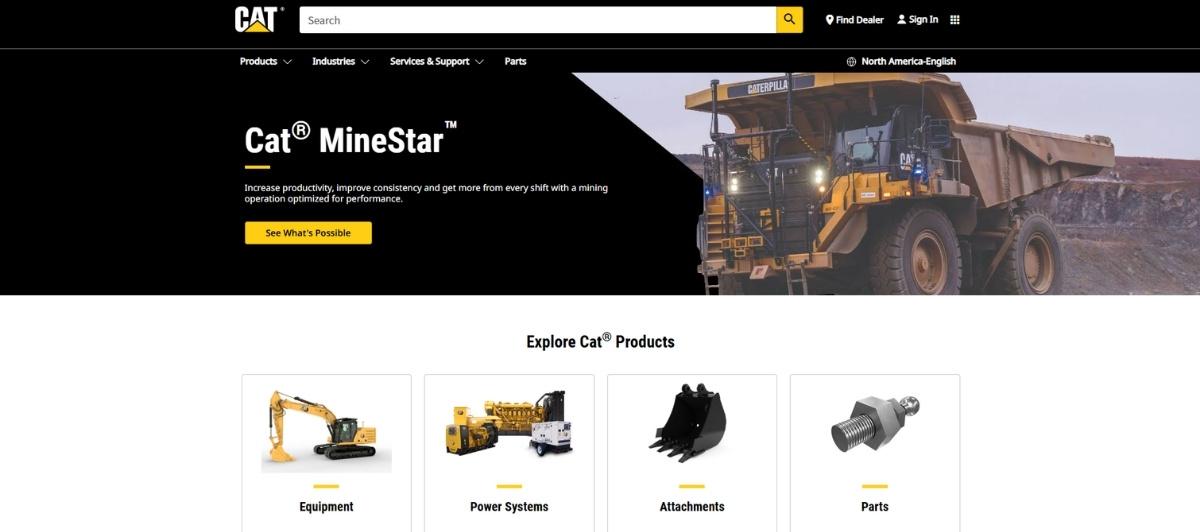
Caterpillar‘s design loads an easy to use region-selection map for visitors, which both helps narrow where they should look for products and services and describes the sheer scale of the company and what it can offer. Their tagline, “Let’s Do the Work,” comes with satisfying images of happy employees interacting on-the-job and comes with clickable thumbnails for the construction machinery they sell. Uniquely, Caterpillar offers descriptions for businesses owners about different areas of improvement for any company that they could help improve.
8. Marlin Steel

Marlin Steel makes you feel like you’re there with an immersive video loop on the homepage under their main tagline, “Quality Engineered Quick.” Their site’s small graphics all add a responsive feel to the selection options, and getting a quote for any particular manufacturing question is easy with a sign-up field in the middle of the main slider. Their “What We Do” subsection links to technical illustrations and thorough descriptions for each stage in their different service processes.
Design lessons from the best manufacturing website designs
Look across the eight sites above, and a pattern emerges. Every one balances an attractive and functional website with the practical demands of the manufacturing industry. Many manufacturing websites fail at exactly this, choosing either heavy technical documentation with no visual appeal or a modern design that never explains what the company actually makes.
What each site highlights
Each example takes a different visual approach to the same problem:
| Site | Design strength |
|---|---|
| Tymetal Corp. | Educational content that makes complex products understandable |
| Independent Machine Company | Long service descriptions paired with images for intuitive design |
| Fairlawn Tool Inc. | Action-oriented imagery with minimal text, a strong example of clarity |
| Cisco | Layered navigation that organizes technical products at scale |
| Lockheed Martin | High-resolution visuals conveying sophistication to a specialized target audience |
| Zeon Chemicals | Concise messaging that defines a niche product in one line |
| Caterpillar | Region-based entry points that simplify a vast catalog |
| Marlin Steel | Video-led storytelling with a quote request built into the hero |
The key pages worth getting right
A seamless user experience depends on a handful of pages doing their job well. Before your next redesign, confirm your site matches this checklist:
- Homepage with clear messaging that states what you make within the first screen
- Capability or services pages explaining processes for buyers new to your specialty
- Product pages with a user-friendly design that surfaces specs without clutter
- About and facility pages that put a human face on your operation
- Contact and quote pages that make the next step effortless
The takeaway is that visually appealing and useful are not opposing goals. Zeon Chemicals proves concise messaging can carry a technical brand, while Marlin Steel shows how a strong visual approach lifts customer engagement without burying information. Getting both right is what turns a site into a working sales asset.
What technical buyers actually need from your site
The visitor evaluating a manufacturing business is rarely a casual browser. They’re an engineer checking tolerances, a procurement lead comparing three suppliers, or a designer confirming a material will hold up. The best manufacturing websites prioritize clear product and capability pages built for exactly that scrutiny.
Give every product room to breathe
Detailed product pages are the backbone of any manufacturing site. Creating dedicated pages for each product enhances SEO while giving buyers the technical depth they need. Product specifications should be clearly displayed so buyers can assess whether an item fits their requirements without emailing your sales team first.
A complete product page typically includes:
- Material specs and dimensional data presented in scannable tables rather than dense paragraphs
- Downloadable spec sheets that a buyer can forward to their team or attach to a requisition
- Real product photography rather than generic stock, showing the item as it actually ships
- Videos of products in use, which enhance understanding and engagement far beyond static images
- Industry-specific certifications displayed near the relevant product pages, the way Fairlawn Tool lists its credentials
Build a technical resource center
Beyond the product catalog, technical resource centers offer downloadable CAD files, compliance documents, and installation guides. For a specialist in secure gate systems, industrial plating services, or modular buildings, these documents shorten the evaluation cycle considerably. Tymetal Corp. does a version of this with its educational resources, explaining a complex topic clearly enough to win business from buyers who arrive uncertain.
Navigate for multiple buyer types
Top manufacturing websites use intuitive navigation tailored for multiple buyer types, since an engineer and a procurement officer look for different things. Clear navigation helps users find information quickly and easily, and a prominent search bar prevents visitors from getting lost in a deep product catalog.
Caterpillar’s region-selection map and Cisco’s three-level menu both show how large product offerings can stay navigable without overwhelming visitors. This kind of content strategy and information architecture is where thoughtful WordPress development makes the difference.
Proving you can actually deliver
In manufacturing, credibility is currency. A buyer weighing an unfamiliar industrial supplier needs reassurance before they’ll risk a production schedule on you. The strongest manufacturing sites build that confidence with concrete proof rather than adjectives.
The proof points that carry the most weight include:
| Trust signal | Why it works |
|---|---|
| Industry certifications | Verifies quality standards; most effective displayed near relevant product pages |
| Customer and client logos | Serves as instant social proof that established companies rely on you |
| Case studies with measurable outcomes | Enhances buyer confidence with real numbers rather than claims |
| Testimonials | Alleviates purchase anxiety for potential clients evaluating a new supplier |
| Sustainability metrics | Increasingly expected as buyers weigh supply chain responsibility |
Numbers make the case better than adjectives. C.H.I., for instance, achieved a 35% increase in its quote page conversion rate after improving its site experience, the kind of measurable outcome that convinces a skeptical marketing team that web investment pays. Leading manufacturing platforms increasingly showcase measurable business outcomes instead of just products, framing capability in terms of what a customer gained.
Lockheed Martin builds technical credibility through high-resolution imagery of critical work and a constantly refreshed press section, while Zeon Chemicals leans on its legacy since the 1950s. Whatever your industry niche, whether onshore technologies, metal fabrication, or specialty chemicals, showing rather than telling is what converts visitors into qualified leads.
Performance fundamentals that keep buyers on the page
A manufacturing site can have brilliant content and still fail if it’s slow or awkward on a phone. Technical buyers research from job sites, trade shows, and production floors, and their patience is thin. Performance is not a cosmetic concern here, it directly determines lead generation.
Speed and mobile are conversion levers
The data is blunt. A 1-second delay in page load time can reduce conversions by 7%, and 61% of users won’t return to a mobile site that gave them trouble. Mobile-friendly design is essential for both SEO performance and user retention, since Google ranks on mobile-first indexing.
Fairlawn Tool’s site scales cleanly across mobile devices and full-size computers, which is exactly the baseline every manufacturer should meet.
Visual quality without the weight
High-quality images and video communicate capability in a way text cannot, and strong visuals genuinely enhance user engagement and retention. Marlin Steel’s immersive homepage video loop is a good example of visual interest that reinforces the brand rather than distracting from it.
The challenge is delivering that quality without hurting load times, which is why compression, lazy loading, and fast managed hosting paired with speed optimization matter so much for image-heavy manufacturing sites.
Search visibility for industrial products
Getting found requires ongoing work: regularly updating metadata with targeted keywords boosts visibility, building high-quality backlinks improves rankings, and dedicated pages for each product multiply the queries you can win. For a manufacturing business competing against larger catalogs, this structural SEO work is often the highest-return investment available.
The rise of self-service and interactive tools
Manufacturing websites are evolving into AI-driven interactive platforms rather than static brochures. Modern manufacturing websites focus on self-service digital tools that let buyers answer their own questions and move forward without waiting on a sales call. The result is faster sales cycles and better-qualified procurement leads.
The interactive features reshaping the industry include:
- Interactive configurators that let users build custom products and request quotes for their exact specifications
- Instant quoting and online configuration tools, which measurably shorten the path from interest to purchase order
- Customer portals where clients track orders, review history, and view analytics
- AI-powered assistance, including smart chatbots that help visitors find the right solution within a complex catalog
- Live chat features, which significantly improve user satisfaction when a buyer has a quick technical question
- Digital twin functionality, allowing simulation of production environments before committing to changes
Marlin Steel’s quote sign-up field placed directly in the main slider is a simple version of this idea: remove every step between interest and inquiry. Prominent contact forms and clear calls to action throughout the site guide users toward the desired action, and prominent calls-to-action reliably improve conversion rates on manufacturing websites.
Together with a flexible content management system, these tools turn a site into an active part of the sales process rather than a static reference. Enhanced customer experiences come from simplifying complex industrial solutions, not from adding features for their own sake.
Where manufacturing is heading in 2026
The industry’s digital transformation is changing what buyers expect to find online. Manufacturing platforms now enable real-time, data-driven decisions and operational efficiency, and the websites that reflect these shifts signal a company is keeping pace.
Several trends stand out:
- AI-driven sourcing and integrated logistics are becoming key features of leading manufacturing platforms, streamlining how buyers find and receive materials.
- Additive manufacturing ecosystems are facilitating faster, more decentralized production, changing lead times across many industries.
- Sustainability and supply chain transparency are now front-and-center priorities, with websites for 2026 emphasizing green chemistry and sustainable materials.
- Worker-centric technology is being integrated for safety and communication, reflecting a broader focus on the people inside production environments.
Manufacturers who address these themes on their sites, alongside their core product listings, position themselves as forward-looking partners rather than commodity suppliers. Whether you work with a specialist web design agency or an in-house team, aligning your website with where the industry is going is what keeps it relevant. Ongoing WordPress maintenance makes sure that content stays current as your capabilities expand.
Engineer a better manufacturing website with Freshy
The best manufacturing websites all do the same core things: they give technical buyers the specs they need, prove capability with real evidence, load fast on every device, and let visitors move forward without waiting on a sales call.
Here are the key takeaways from this guide:
- Build detailed product pages with clear specs, real photography, and downloadable spec sheets
- Add a technical resource center with CAD files and compliance documents
- Display certifications, client logos, and case studies with measurable outcomes
- Prioritize fast load times and mobile-friendly design, since delays cost conversions
- Add configurators, instant quoting, customer portals, and live chat for self-service buyers
- Address sustainability, supply chain transparency, and digital transformation openly
Whether you’re a regional fabricator or a global industrial supplier, your website should communicate technical precision as clearly as your production floor does. Freshy builds high-performing WordPress websites for manufacturers and industrial businesses nationwide, backed by ongoing support and maintenance. When you’re ready to turn more site visitors into qualified leads, tell our team about your project.
Frequently asked questions
What makes a great manufacturing website?
The best manufacturing websites feature detailed product pages with clear specifications, strong visuals that communicate capability, intuitive navigation for multiple buyer types, prominent contact forms, and fast load times across mobile devices.
What do technical buyers look for on manufacturing sites?
Technical buyers need material specs, dimensional data, downloadable spec sheets, CAD files, compliance documents, and industry certifications. They want to verify capability quickly without contacting a sales team first.
How important is site speed for manufacturing websites?
Very. A 1-second delay in page load time can reduce conversions by 7%, and 61% of users won’t return to a mobile site that gave them trouble. Speed directly affects both rankings and lead generation.
What trust signals work best for manufacturers?
Industry certifications displayed near relevant product pages, customer logos as social proof, case studies with measurable outcomes, and testimonials. C.H.I. achieved a 35% increase in quote page conversions by improving its site experience.
How are manufacturing websites changing in 2026?
They’re becoming interactive platforms with configurators, instant quoting, customer portals, AI chatbots, and digital twin simulations. Sustainability, supply chain transparency, and additive manufacturing are also increasingly prominent themes.