A homeowner enters their home address into a home value estimator, gets a rough estimate, and immediately wonders if it’s accurate. The next step almost every person takes is searching for a local real estate agent or a professional appraiser to get a more accurate estimate. First impressions aren’t made in person anymore. They happen online, and your website is doing the talking before you ever pick up the phone.
This article breaks down 14 of the top real estate appraisal websites and exactly what makes each one earn business.
Here’s what we cover:
- What separates a high-converting real estate appraisal website from a forgettable one
- 14 standout real estate appraisal websites, reviewed and linked
- The design and trust-building choices worth borrowing
- What every appraisal website needs to generate consistent leads
- How online home value estimator tools fit into the bigger picture
We’ve built websites for real estate professionals across the US, and the team here knows what it takes to turn a site visit into a booked appraisal. Take a look at our real estate web design work to see what’s possible.
What makes a real estate appraisal website convert
When a homeowner needs a professional appraiser, they’re often already anxious. They may be refinancing, going through a divorce, contesting a tax assessment, or preparing to sell in today’s market. They need someone they can trust with the most significant asset they own. Your website has to communicate that trust before a single word is exchanged.
Here’s what consistently separates the best real estate appraisal websites from digital brochures that simply exist:
- They lead with credibility, not services. Years of experience, certifications, comparable sales data expertise, local market knowledge, and client testimonials all signal competence before a visitor even reads your service list. The appraisal process involves a lot of trust, and the best sites build that trust on the home page before asking for anything in return.
- They make the next step obvious. Whether it’s requesting a free quote, calling the office, or submitting property details through a form, every page should point toward one clear action. Visitors looking for a more accurate estimate of their home’s value or a professional opinion on comparable homes don’t want to hunt for a contact button.
- They communicate local expertise. A professional appraiser who knows the local market, recent sales data, local market trends, and buyer demand in a specific area is worth more to a client than a national firm with no local roots. The best appraisal websites make that geographic expertise unmistakable, including service area details, local market commentary, and region-specific experience.
- They explain what clients can expect. Many homeowners have never been through the appraisal process. A site that explains what happens during an in-person inspection, how comparable sales are used, and what factors affect estimated home value educates the visitor and removes the hesitation that costs appraisers leads every day.
| What loses clients | What wins them |
|---|---|
| No credentials visible | Licenses, certifications, and years of experience upfront |
| Generic service list | Specific appraisal types explained clearly |
| No local market context | Service area, recent activity, and local expertise highlighted |
| Buried contact options | Quote request form and phone number on every page |
| No social proof | Client testimonials and sample reports featured prominently |
Top 14 real estate appraisal websites of 2026
When homebuyers need to get an appraisal for a property, they will often pick a company based on its website. A well-designed website is a great way to present a company’s resume in a nice packet that shows past work, an experienced team, and availability.
1. Bowery Valuation

Bowery Valuation uses a minimalist design to communicate a significant amount of information without overwhelming visitors. It introduces its large team and their combined valuation experience alongside its innovative appraisal software. The clean, white, and blue design keeps every detail easy to read, making a strong first impression for clients navigating the commercial real estate market.
2. KS Appraisal

KS Appraisal uses sliding property images to draw visitors in from the moment they land. The red, black, and white color scheme unifies every section of the site, with key information highlighted in red and buttons linking clearly to services and a contact form. It’s a site that understands the value of visual hierarchy in converting curious visitors.
3. Metroplex Appraisal Network
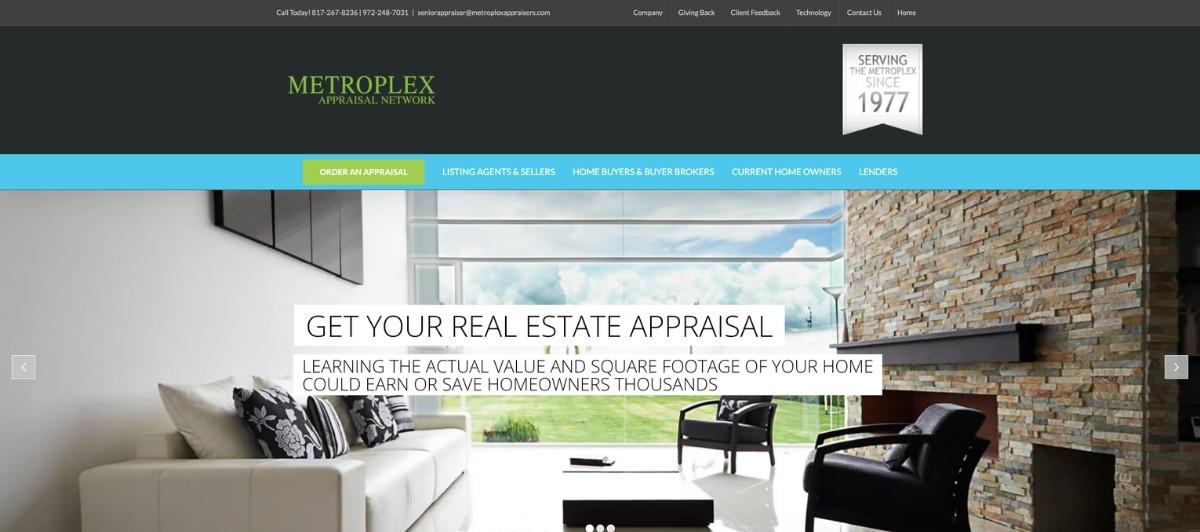
Metroplex Appraisal Network stands out with a distinctive gray, green, and blue palette that feels fresh against the typical white-heavy appraisal website. A company video and client testimonials are accessible by scrolling the home page. The badge noting their service since 1977 anchors the site’s credibility immediately and signals deep local market knowledge.
4. Titan Real Estate

Titan Real Estate anchors its identity in the Austin, Texas, skyline, immediately communicating local market expertise to anyone searching for a regional appraiser. Company statistics on the home page reinforce prestige, and logos of past clients serve as visible social proof. It’s a site built to appeal to both individual homeowners and institutional clients.
5. Initech Appraisals

Initech Appraisals combines a clean slideshow with minimal text on a white background, creating a professional and uncluttered impression. A definition of the appraisal process at the top of the home page is a smart addition for visitors who are unfamiliar with the process and need reassurance before they reach out for a precise valuation.
6. NYC Real Estate Appraisals

NYC Real Estate Appraisals uses strong imagery and a distinctive alternating dark blue and white design to stand out in a competitive market. The site clearly communicates commercial, residential, and consulting services, and client testimonials at the bottom of the home page provide the social proof that converts undecided visitors into inquiries.
7. Real Estate Appraisals Austin

Real Estate Appraisals Austin organizes its content in dark blue boxes with yellow text, creating a distinctive visual identity that makes key information easy to find at a glance. The phone number sits at the very top of the home page, and customer testimonials at the bottom of the page reinforce confidence in the company’s professional opinion.
8. Arias Appraisals

The mustard yellow sweep above the fold on Arias Appraisals grabs immediate attention without feeling aggressive. The same accent color appears strategically throughout the site to highlight important information. A unique offering, drive-by appraisals, is prominently featured, giving the company a differentiator that stands out in the local real estate market.
9. Vanderbilt Appraisal Company

A stunning Manhattan skyline photo greets visitors to Vanderbilt Appraisal Company, immediately anchoring the firm’s identity in one of the most complex and high-value real estate markets in the world. Two shades of green against white create a sophisticated look as visitors scroll through residential, commercial, and consulting services.
10. Murphy Appraisal Group

Murphy Appraisal Group brings an airy, light feel through a sky blue and white design with ocean imagery that subtly suggests beach and coastal property expertise. A photo gallery in the menu and a phone number at the top of every page keep essential contact details accessible throughout the browsing experience.
11. Sun Point Appraisals, Inc.

Sun Point Appraisals, Inc. pairs a striking full-screen photo backdrop with an animated typing effect that catches the eye without distraction. A phone number in the upper left corner is there immediately for visitors who don’t need to scroll further. It’s a site that understands some clients arrive ready to act and removes every obstacle between them and contact.
12. Houston Appraisal Company

The Houston Appraisal Company uses a bold multicolor palette, combining blue, yellow, orange, gray, and white to emphasize different sections of the site. An orange “Order an Appraisal” button at the top of the home page ensures that visitors who arrive ready to act don’t have to scroll or search to take the next step.
13. Carneghi-Nakasako and Associates

Carneghi-Nakasako and Associates opens with a simple, authoritative statement about its commercial real estate specialty. Owner photos visible as you scroll, combined with three prominent contact buttons and a clean dark blue, white, and gray design, make this site an efficient tool for attracting and converting commercial appraisal clients.
14. Kuehnert Appraisal and Consulting

Kuehnert Appraisal and Consulting uses upscale photography and a sophisticated logo to communicate premium positioning. Well-organized content blocks with white, gray, and teal backgrounds with gold accents create a layered visual experience that conveys the kind of expertise clients expect when they need a more accurate estimate than any online home value estimator can provide.
Design choices worth borrowing
The best real estate appraisal websites share specific choices that make them more effective at converting visitors into booked appraisals. Here are the ones most worth applying directly.
Lead with credentials, not a pitch
Homeowners deciding between appraisers don’t need convincing that they need an appraisal. They need reassurance that you are the right professional for it. Licenses, certifications, years serving the local market, and the types of properties you regularly appraise should appear on the home page, not buried in an About section three clicks deep.
Add a sample appraisal report
One of the most underused trust signals in real estate appraisal web design is a downloadable sample report. It shows potential clients exactly what they’ll receive, sets clear expectations, and positions your firm as transparent and thorough. The McDonald Appraisal Group is a strong example of how effective this single page can be.
Feature a mortgage calculator or home value estimator tool
Online home value estimators and home value estimate tools are where many homeowners begin their research process. A site that offers a simple, free home value estimator or mortgage calculator gives those visitors a reason to stay and engage before they’re ready to request a full appraisal. It’s a useful starting point that keeps your firm top of mind when they’re ready to move forward.
Explain the appraisal process clearly
Most clients have never been through the appraisal process before. A short, plain-language explanation of what happens during an in-person inspection, what data points are used, how comparable sales and recent sales data factor into the final estimate, and how long the process takes removes the uncertainty that often delays or prevents a first inquiry.
Make the quote request form effortless
Name, email, phone number, street address, and a brief description of the property. That is all a first-contact form needs. Every additional field reduces submission rates. The goal is to start the conversation, not to collect a complete set of property details before you’ve ever spoken to the client.
What every real estate appraisal website needs
Whether you’re an independent appraiser or managing a multi-appraiser firm, these are the non-negotiables every real estate appraisal website should have before you invest in any marketing.
- A clear, specific service list. Residential appraisals, commercial appraisals, estate appraisals, divorce appraisals, tax assessment appeals, and consulting services all serve different clients with different needs. Each deserves its own page with clear details on what the service includes, who it’s for, and how to request it.
- Location and service area information. A potential client searching for a local real estate agent or appraiser wants to know you serve their area without having to read three paragraphs to find out. Display your service area on the home page, in the footer, and on a dedicated service area page. This also improves local SEO visibility significantly.
- Testimonials placed near CTAs. Client reviews and testimonials are most effective when they appear next to the action you want visitors to take. A testimonial above a “Request a Free Quote” button tells the visitor that other homeowners just like them trusted this firm and were satisfied with the result.
- A blog covering local market insights. Posts on local market trends, how interest rates affect home prices, what factors determine a home’s value, and the difference between an online home value estimator and a professional appraisal position your firm as the most knowledgeable option in the area. Our SEO services help appraisal firms build exactly this kind of content-driven visibility over time.
- Mobile-optimized design. Many homeowners research appraisers on their phones while reviewing a list price, comparing comparable homes, or calculating home equity. A site that doesn’t work well on mobile loses those visitors before they ever see your credentials.
- Fast load speed. Just like an appraisal report needs to be timely and accurate, your website must stay updated, secure, and optimized to remain effective. Our WordPress speed optimization service keeps appraisal websites loading fast across every device and browser.
How to build a site that books more appraisals
The best real estate appraisal websites function as 24/7 business development tools, building credibility, answering questions, and generating quote requests around the clock. Here’s how to build one that performs.
- Invest in professional real estate web design. A template site can get an appraisal firm online quickly, but it rarely communicates the level of professionalism and expertise that commands premium fees in today’s market. A custom-built WordPress website built around your firm’s specific services, service area, and client base performs significantly better over time.
- Understand where online estimators fit. Online home value estimators like Zillow’s Zestimate, Redfin’s home value tool, and other online home value estimators give homeowners a rough estimate based on available data. Most online estimators carry a median error rate of 2 to 7 percent, and they can’t account for recent renovations, home improvements, specific property details, or the nuances of a local market. Your website should acknowledge this gap and position your professional opinion as the more accurate estimate that online tools simply cannot provide.
- Build content around real client questions. Homeowners searching the real estate market ask things like “how accurate is my home’s Zestimate,” “what affects my home’s estimated value,” “how does square footage affect appraisal value,” and “do home improvements increase appraised value.” Blog posts and resource pages built around these questions bring in organic traffic from exactly the right audience at exactly the right moment in their decision process.
- Keep the site secure and current. A real estate appraisal website that looks outdated, loads slowly, or carries security warnings undermines the professional credibility your firm has spent years building. Our WordPress maintenance services protect your site with regular updates, security monitoring, and performance checks so your online presence stays as reliable as the appraisals you deliver.
If your current real estate appraisal website isn’t generating the inquiries your business deserves, get a quote and let’s talk about building one that does.
Your appraisal business deserves a website as precise as your work — Freshy makes that happen
The best real estate appraisal websites share one quality: they make a potential client feel confident before the first conversation. From credentials and service details to client testimonials and clear quote request forms, every element should build the trust that turns a browsing homeowner into a booked appraisal.
Key takeaways:
- Lead with credentials, certifications, and local market expertise before listing services
- A sample appraisal report is one of the most effective and underused trust signals available
- Online home value estimators create demand for professional appraisers, not competition
- Testimonials placed near CTAs convert browsers into inquiries more effectively than anywhere else
- A blog covering local market trends and comparable sales builds long-term organic visibility
- Mobile optimization and fast load speeds are non-negotiable for any professional appraisal site in 2026
We’ve helped real estate professionals and service businesses across the US build WordPress websites that generate real, consistent leads. Whether you’re starting fresh or need a full redesign, get a quote and let’s build a real estate appraisal website that reflects the precision and professionalism you bring to every valuation. You can also explore our portfolio to see what’s possible.
FAQs
What should a real estate appraisal website include?
The best real estate appraisal websites feature service pages, licensing credentials, local market expertise, client testimonials, a quote request form, and a clear explanation of the appraisal process for every subject property type.
How accurate are online home value estimators?
Online home value estimators provide a useful starting point but carry a median error rate of 2 to 7 percent. Most estimator home tools can’t reflect recent improvements, home renovations, usable space, bathroom count, or square foot adjustments that affect the true house worth.
What is the difference between an online home value estimate and a professional appraisal?
An online estimate uses available data to generate a rough figure. A professional appraiser produces a detailed report covering the subject property’s home details, comparable sales, on-market homes, homes selling nearby, and other factors that require human expertise to assess accurately.
Do real estate appraisers need a website?
Yes. Most homeowners searching for a local real estate agent or professional appraiser start online. Without a website, your firm is invisible to the majority of potential clients researching house worth, a home sale, or the housing market in your area.
How much does a real estate appraisal website cost?
A professionally built real estate appraisal website typically costs $2,500 to $8,000, depending on service pages, local SEO features, and tools like a home value estimator updated regularly to reflect current housing market data and homes selling in your area.