Buying a car used to mean a weekend of dealership visits. Now most of the buying process happens on a screen, and 71% of consumers prefer a hybrid approach that blends online research with an in-person test drive. That shift puts enormous weight on a dealership’s website, and on the online car marketplaces where car shoppers do their homework first.
Here’s what this guide covers:
- The 5 best dealership auto sales websites for 2025, reviewed
- The major online car marketplaces where used car shoppers actually compare listings
- The pricing tools and deal ratings that help car buyers avoid overpaying
- How digital retailing, home delivery, and car vending machines changed buying
- Common questions before buying a car online
At Freshy, we build high-performing WordPress websites that help businesses convert visitors into customers. If any of these sites spark an idea for your own dealership, we can help bring it to life.
Dealership sites that balance flash and function
Auto dealerships sell higher-budget products with an implicitly visual side, making even a used car dealership’s attention to how their vehicles appear both online and in-person a crucial part of getting customers to convert.
But the website of a car dealership doesn’t necessarily need lots of bells and whistles, like excessive pop-up notifications that you sometimes find.
1. Anderson Lincoln
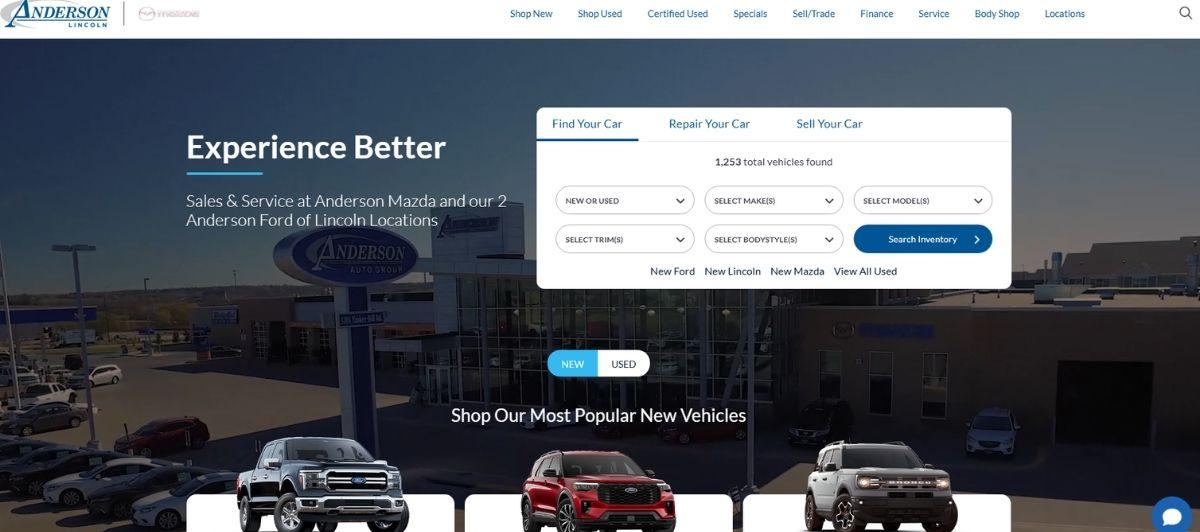
Anderson Lincoln advertises its most popular products with high-resolution imagery right at the top of the page, even before scrolling to the homepage’s center. Dealerships have a lot of inventory flux, so this is a good idea because it shows what’s most new and available, and you can close the slide whenever. More generally, the site’s background video offers a pleasant view of the business’s location with three very direct calls to action, “Find,” “Sell,” or “Service” your vehicle.
Below, they have a more complex query menu narrowing which cars are in stock for any customer’s needs and a series of slides that more statically describe who they are and what they offer. Their balance of initial dynamic presentation and still-image sequencing is an effective first look into their business!
2. Regency Toyota

Based in Vancouver, CA, Regency Toyota‘s website shows that they’re both a used and new car dealership, meaning their inventory is probably high and they don’t have as much a need to advertise specific models more than quality dealership service otherwise. Their calls to action are front-and-center on their homepage and scrolling down brings you to a personalizing description about how Regency wants to help you make an informed purchase instead of a rushed one.
Along with a slideshow image that shows a Regency employee celebrating blood donation efforts in Canada, this helps build more community-based trust in their brand. They aren’t just trying to sell you a car and get you out the door more than helping you make the decision that’s best for your needs, so you’re as satisfied as possible.
3. Land Rover Tampa

Succeeding with a less-is-more strategy, Land Rover Tampa delivers crucial information in a compelling way, and without needing to deviate from more classic design. They advertise new vehicles right on their homepage slider with clear pricing and call to action buttons for each. Just below, they let users scroll between the general models they offer for clicking toward a more specific look at models based on user preference.
While their header bar offers a thorough menu of all the services they offer, the rest of the site is mostly an informative description of their mission and an easy-to-find menu of their most popular services, including servicing vehicles and financing options.
4. Volvo Cars Manhattan

Offering a sleek website with just a little more than the essentials was the right choice for Volvo Cars Manhattan. The first things you see are two calls to action for viewing their inventory: a “View [Specific Trending Model]” option and a “Browse Inventory” option with associated blank fields for model, year, and the number of used or new versions of a particular car.
With evenly-spaced, large and clickable images denoting their categories, the sophisticated tone of “Looking for offers?” is an effective way to advertise discounts and other deals for a more boutique dealership while “Join Our Service Clinic” characterizes their repair services as both club-like and highbrowed.
5. Austin Infiniti

Last, but hardly least, Austin Infiniti dealership brings a site that supports the middle ground between sophistication and accessibility. While their homepage slider shows their newest products in action-oriented, immersive video, just below is a simple-looking search bar for looking up the value of your own vehicle in case you wish to sell. This is a very smooth transition between describing that they offer new, exciting vehicles, and also buy used ones, all with minimal text and heavy visuals.
They’re proud to show a plethora of very recent customer testimonials from many social media channels and offer a concise but punchy welcome description near the bottom to keep you focused on how they want you to feel about their services without just getting lost in flowery language.
The online marketplaces where car shoppers really start
Before a car buyer ever visits a dealership site, most of them start on a third-party platform that aggregates used car listings from across the market. Understanding these online car marketplaces matters whether you’re shopping for a dream car or running a dealership that needs to compete with them. Each one serves a slightly different buyer.
| Platform | Monthly traffic | Best known for |
|---|---|---|
| Autotrader | 28M+ visitors | Huge inventory of new and used cars |
| Cars.com | 25M+ users | Strong network of local dealerships |
| CarGurus | 20M visitors | Deal ratings on every listing |
| AutoTempest | Aggregates 100M+ vehicles | One search across many car sites |
| TrueCar | ~1M pre-owned vehicles | Showing what other buyers paid |
Aggregators that pull it all together
If you want to compare listings without visiting ten car sites, aggregators are the answer. AutoTempest aggregates millions of used car listings from multiple platforms in one search, pulling from over 100 million vehicles including eBay Motors, Craigslist, and dealer inventory. It doesn’t sell cars itself; it just surfaces all the results so you can find a specific vehicle fast.
Marketplaces with deal ratings
CarGurus built its reputation on transparency. It labels each listing as a Great Deal, Good Deal, or Overpriced by comparing the asking price against market data and price history. AI tools now flag overpriced listings automatically, helping car buyers spot a fair deal at a glance. CarGurus charges dealers a $99 fee upon a vehicle sale, which is worth knowing if you sell through it.
Platforms built on price transparency
TrueCar takes a different angle, showing what other buyers actually paid for a specific vehicle in your area. That real-time data on true market pricing helps consumers avoid overpaying and walk into a negotiation informed. With nearly one million pre-owned vehicles nationwide, it’s a strong starting point for used car shoppers doing their own research.
The giants: Autotrader and Cars.com
The two heavyweights remain essential. Autotrader attracts over 28 million monthly visitors and lists an enormous range of new and used vehicles. Cars.com has more than 25 million monthly users and a strong network of local dealerships, making it a reliable place to find fair prices from nearby sellers. The best strategy is to compare vehicle listings across several of these platforms before making an offer.
Buying a car online: how the process actually works now
Digital retailing has reshaped car buying from a lot-based haggle into a mostly online experience, complete with remote purchasing and home delivery. Nearly all major car sales websites now offer home delivery services, and buyer satisfaction with these digital tools is high. More than 84% of buyers report satisfaction with AI-powered digital tools that guide the buying process.
The no-haggle and home-delivery players
Carvana pioneered the fully online purchase, offering home delivery and its signature car vending machines for pickups. CarMax offers a no-haggle pricing model with a nationwide inventory, letting buyers skip negotiation entirely. Both appeal to car shoppers who value convenience and a fixed, fair price over the traditional back-and-forth.
Auctions and private-party sales
Not every purchase runs through a dealer. eBay Motors allows auction bidding, though its bids are non-binding, which changes the buying process. Facebook Marketplace and Craigslist handle local transactions between private sellers, and private-party listings on Facebook Marketplace surged for cars under $10,000. Craigslist offers free listings but lacks buyer protection, so vehicle history checks matter even more there.
Why vehicle history reports are non-negotiable
Whether you buy from a dealer or a private seller, a comprehensive vehicle history report is crucial for checking accident and title status. Combined with pricing tools, deal ratings, and financing options like loan calculators, these reports are the key features that separate a confident purchase from a costly mistake. Market data and deal ratings help buyers compare listing prices against historical values, so you know a good deal when you see one.
Here’s an additional section to slot in, most naturally placed right after “Buying a car online: how the process actually works now” and before “What dealership sites can learn from the marketplaces.” It uses professional elements throughout rather than plain paragraphs.
Beyond the big names: specialized tools worth exploring
The best used car websites cover the mainstream, but savvy car shoppers know the market has specialized corners worth exploring. Whether you’re after a rare find or just want deeper data before you buy, these tools fill gaps the giant marketplaces leave open.
Match the platform to what you’re buying
Different vehicles call for different platforms. Use this quick reference to point your search in the right direction:
| What you’re shopping for | Where to look | Why |
|---|---|---|
| Collector cars and classics | Bring a Trailer, Hemmings | Enthusiast audiences and auction formats built for rare finds |
| Trucks and SUVs | Autotrader, CarGurus | Deepest inventory of the most popular vehicles across every trim |
| New vehicles at a fair price | TrueCar, Edmunds | Real new car prices and what others actually paid |
| Buying across state lines | Carvana, nationwide dealers | Home delivery and car shipping handle the distance |
Lean on research-grade data
Beyond listings, the strongest platforms give you advanced analytics to shop smart. A few features are worth prioritizing:
- AI-powered pricing tools that read pricing trends in real time and flag when a listing sits above market
- Dealer ratings that surface which sellers have a track record of fair, transparent deals
- Edmunds research and similar editorial reviews that compare reliability, ownership costs, and resale across many vehicles
- True market value estimates that translate raw data into a number you can negotiate against
As one industry chief revenue officer put it, buyers now expect the same data transparency from a car purchase that they get from any other major online buy. That expectation is exactly why these analytics tools have moved from nice-to-have to essential.
Follow a simple step-by-step guide
To pull all of this together, a repeatable process keeps any purchase on track:
- Set your budget and decide between trucks, SUVs, or a specific model
- Compare listings across two or three platforms to establish fair pricing trends
- Run AI-powered pricing tools and check dealer ratings on your top candidates
- Pull a vehicle history report and confirm true market value with Edmunds research
- Arrange financing, then sort out home delivery or car shipping if the car crosses state lines
That kind of structured access to data and listings is what turns a stressful purchase into a confident one, and it’s the standard every modern dealership site should aim to match.
What dealership sites can learn from the marketplaces
For a dealership, the lesson from Autotrader, CarGurus, and Carvana is clear: car shoppers now expect transparency, speed, and self-service tools before they ever call. The five dealership sites above succeed because they bring some of that marketplace polish to their own inventory.
The features that move a modern car shopper toward conversion include:
- Prominent inventory search with filtering tools by body style, price, model, and year, the way Volvo Cars Manhattan does it
- Clear pricing and calls to action on featured vehicles, like Land Rover Tampa’s homepage slider
- Trade-in and instant-offer tools, echoing Austin Infiniti’s built-in vehicle valuation search
- Trust signals like customer testimonials and community involvement, which Regency Toyota and Austin Infiniti both use well
- Financing tools such as loan calculators that let buyers estimate payments before visiting
A dealership website that offers a personalized experience with transparent pricing keeps buyers on-site instead of bouncing to a third party platform. That’s where thoughtful WordPress development and fast managed hosting pay off, since inventory-heavy car websites need to load quickly and handle constant updates. Strong SEO then makes sure local car buyers find your listings before they find a competitor’s.
Drive more sales with a site built by Freshy
The best auto sales websites, whether a single dealership or a marketplace reaching millions, all do the same core things: they make inventory easy to search, pricing transparent, and the path to purchase convenient.
Here are the key takeaways from this guide:
- Car shoppers start on marketplaces like Autotrader, Cars.com, and CarGurus, so your site has to match their polish
- Deal ratings, price history, and vehicle history reports build the trust that closes sales
- Digital retailing, home delivery, and no-haggle pricing are now buyer expectations, not perks
- Give visitors real filtering tools, clear pricing, and financing calculators on your own site
- Use trust signals like testimonials and community involvement to stand apart from a third-party platform
- Fast, well-built dealership sites keep buyers from bouncing to the big marketplaces
Freshy builds high-performing WordPress websites for dealerships and businesses across the country, backed by ongoing support and maintenance. If your auto sales website is ready to bring in more car buyers, get in touch.
Frequently asked questions
What are the best websites for buying a used car in 2026?
Top car buying websites include Autotrader, Cars.com, CarGurus, TrueCar, and Carvana. Aggregators like AutoTempest pull used car listings from many platforms into one search for easy comparison.
How do I know if a used car is fairly priced?
Use platforms with deal ratings like CarGurus, which labels listings Great Deal, Good Deal, or Overpriced. TrueCar shows what other buyers paid, and Kelley Blue Book helps confirm true market value.
Can I buy a car completely online?
Yes. Carvana offers home delivery and car vending machines, and CarMax provides no-haggle pricing with nationwide inventory. Nearly all major car sales websites now offer some form of remote purchasing and home delivery.
Are private-party car listings safe?
Private sellers on Facebook Marketplace and Craigslist can offer fair deals, especially on cars under $10,000, but these platforms lack buyer protection. Always get a comprehensive vehicle history report before buying.
Why do car shoppers use multiple websites?
Each platform has different inventory and tools. Comparing vehicle listings across Autotrader, Cars.com, and CarGurus before making an offer helps car buyers find the best selection and avoid overpaying.